If you’ve enjoyed browsing my Raptor Ecology A to Z lexicon, a great place to explore further is Google Scholar. You can enter any keyword or combination of keywords (for instance, “nesting peregrine California”) to draw out scientific articles on any topic. I have lost weeks of my life there, happily chasing ideas like a sharp-shinned hawk chasing birds through a fir forest, from tree to tree to tree.
There are many important raptor books available as well—I urge you to hit your libraries and bookstores (new and used), and see what you can find. Some of my guiding authors are Newton, Peeters, Bildstein, Clark, Wheeler, Hamerstrom, Liguori, Forsman, Dunne, and Crossley. And there’ve never been so many books available on birds and birding. Another great place to explore in person or online is Buteo Books in San Rafael, California (you can browse the website by species and region, and of course easily order books).
As with most birds, we know far too little about birds of prey. Most books and articles, websites and podcasts, tend to hang out in the “what we know” space, rather than the “what we don’t know” space. The secret that most biologists don’t tell you is this—that the “don’t know” space is much bigger. We are incredibly naïve about the real lives of raptors. We know a bit about some very basic aspects: how they find prey; how they navigate on migration; how birds of prey survive the many human obstacles from poisons to plastics, from habitat loss to human-caused climate change. And most of this knowledge is for well-funded, often threatened species in the wealthiest of countries. Indeed, there are lifetimes of raptor ecology tasks out there.
That said, I want to acknowledge my biases in writing here mostly about North American and northern hemisphere birds of prey. The world is covered with hawks, eagles, falcons, vultures, osprey, kites, and owls, and the farther and deeper you look, the more provocative the stories become.
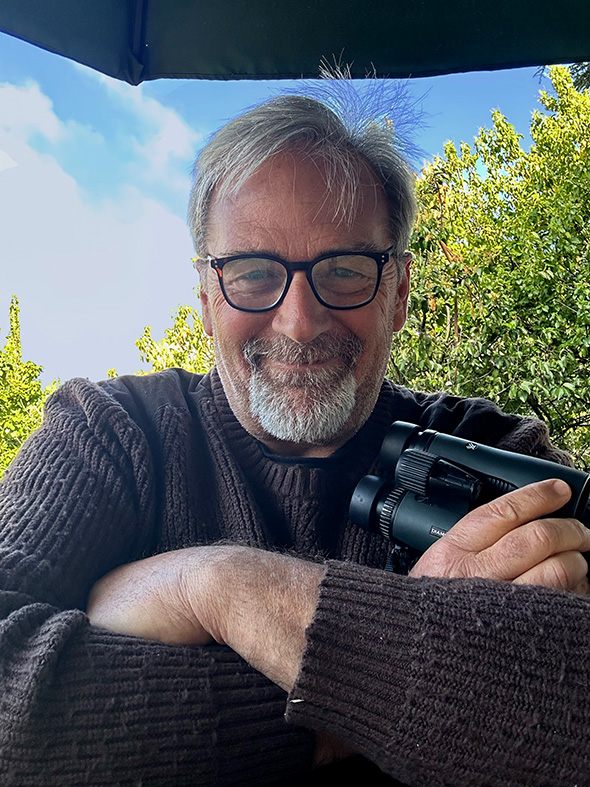
A little more about me
I grew up in California’s San Francisco Bay Area under soaring red-tailed hawks and turkey vultures. An early close encounter with a captive great horned owl at the Coyote Point Museum (now CuriOdyssey) knocked my socks off and triggered a life-long love of raptors. I migrated to the University of California at Davis for college, where a range of raptor species and research came alive, as I met biologists actually studying birds of prey. This is a thing people do! Between coursework and riding my bike around the bird-rich, Sacramento Valley landscapes, I grabbed seasonal internships with the National Park Service, US Forest Service, Bureau of Land Management, and the California Raptor Center.
From 1985 to 2024, I was the director of the Golden Gate Raptor Observatory—a cooperative program of the Golden Gate National Parks Conservancy and the National Park Service. I got to work with a brilliant and energized community of volunteers, all passionate students of birds of prey, and met and learned from biologist colleagues from all over the world. From 2003 to 2011, I taught the long-running Raptor Biology class at the University of California at Davis, an incredible experience that gave me an even wider circle of raptor conservation biologists to learn from.
My hope is that the topics in Raptor Ecology A to Z will help you to study and help raptors. To inspire you to go out in the field and to think about what raptors need to survive. Enjoy your local nesting pair of owls, or the wintering Cooper’s hawk that whips through your yard each week, but also think about the populations of raptors, the dozens and hundreds of birds of that species, and what they need to proliferate. This is the big challenge—preserving populations of wild raptors—assuming that we all want our grandkids to look up someday and see a redtail soaring overhead, and to feel that lift in themselves.
I am happy to receive comments on or critiques of these short essays. Feel free to reach out to me via raptorsarethesolution@gmail.com or allenmfish@gmail.com. Finally, I send great gratitude out to the many colleagues, biologists, teachers, and raptor-geeks who have inspired me across more than four decades.
Raptor on!
Allen