
by Allen Fish
(Full article from RATS Tales December 2025)

(More about Allen, including his eclectic lexicon Raptor Ecology A to Z)
A quarter century ago, I walked out of my house and something caught my eye—a flash of a bird from behind my car. The sound of rapid-fire towhee emergency calls, and the flutter of feathers. The California towhee popped out from under my Subaru’s passenger side and looked up. The Cooper’s hawk in flight wheeled around the rear bumper as quickly. The towhee darted back under the car to the other side. The Coop flew to the front. The towhee came back to my side. The hawk flew around my car two, three, more times, counterclockwise, then over the top, then landed on the street behind the back bumper, and torqued its neck, peering underneath the car. The towhee grabbed the moment and shot out the front end to hide in a small forest of cotoneaster. Another barrage of towhee alert calls exploded around the street. The Coop flew off, for now, spent and still hungry.
I felt sad for the raptor, glad for the towhee—and to be honest, the whole event was thrilling to watch. The towhee escaped the hawk using the car as a barrier. Make no mistake: the towhee was never not in control. This was a well-choreographed shake-off, life in the urban jungle. A lesson in the obstacles and opportunities of urban birds, prey and predator.

This was about the time I really started thinking about raptors in cities. How they adapt to these weird, often arbitrary, layers of too much concrete, metal, and glass, chemicals and garbage. Too many humans creating noise and traffic. And yet, here they are. At least some species. Is this a good thing? We tend to think of raptors, all wildlife species really, in idealized, native, wildland habitats. In the 1970s and 80s, many wildlife agencies like the California Department of Fish and Wildlife created wildland habitat-species models to make the point for all of us—planners, developers, politicos, public—that species need habitats. That’s a critical concept; you can’t save wildlife populations in zoos. But what about in cities?
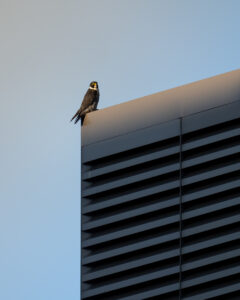
For dozens of reasons, cities aren’t great landscapes to promote long-term, sustainable wildlife diversity, but cities are a lot of what we have. In California, more than 94% of all the humans live in cities of 5,000+ people. We have five of the seven densest urban zones in the country. And yet, in the San Francisco Bay Area, the past twenty years have revealed populations of urban wildlife that weren’t imagined fifty years ago: peregrine falcons, Cooper’s hawks, barn owls, osprey, gray foxes, and coyotes. To see a coyote cross a city street, or a peregrine ripping past a skyscraper, my brain goes on alert. It’s so beautiful, this wild animal! But this environment is so dangerous. How did that species ever become adapted to this concrete landscape? What combination of prey and habitat drew it in, allowed it to survive here?
And here’s the kicker: if it can survive here in this habitat-by-accident, then couldn’t we do a better job planning for wildlife in cities? What if we could increase their survival and their ecological services, whether they are scarfing rats or just living their lives nearby?
The East Bay Cooper’s Hawk Study: 2002-2010
Back in 2002, curious about the survival strategies of hawks in the city, I partnered with ecologist Ralph Pericoli to start a community science study of the nesting Cooper’s hawks of the urban East Bay. We mapped out a roughly 11-square-mile study area including most of Berkeley and Albany, California, and we trained 24 volunteers from the Golden Gate Raptor Observatory (GGRO) to scour each patch for nests and/or nesting activity.
The volunteers were astute nest searchers, and we all loved watching the hawks’ behaviors. We used every clue to locate nests: moth-like display flights, pre-dawn territorial calls, prey plucks, crows mobbing a hawk, fecal whitewash under a tree. We requested sightings from birders via newsletters and listservs. Our goal was to find every nest in the study area each year, to measure the region’s density of nests and total nest numbers.
The nine-year Cooper’s hawk study yielded 95 nests, and you can read about them in full:
- GGRO’s East Bay Cooper’s Hawk Intensive Nesting Survey – 2003 (Ralph V. Pericoli and Allen M. Fish, 2004)
- Nesting Biology of Urban Cooper’s Hawks in Alameda County, California (Ralph V. Pericoli, Emma L. Karsten, Allen M. Fish, and Christopher W. Briggs, 2020); published in eWestern Birds 51, a journal of Western Field Ornithologists
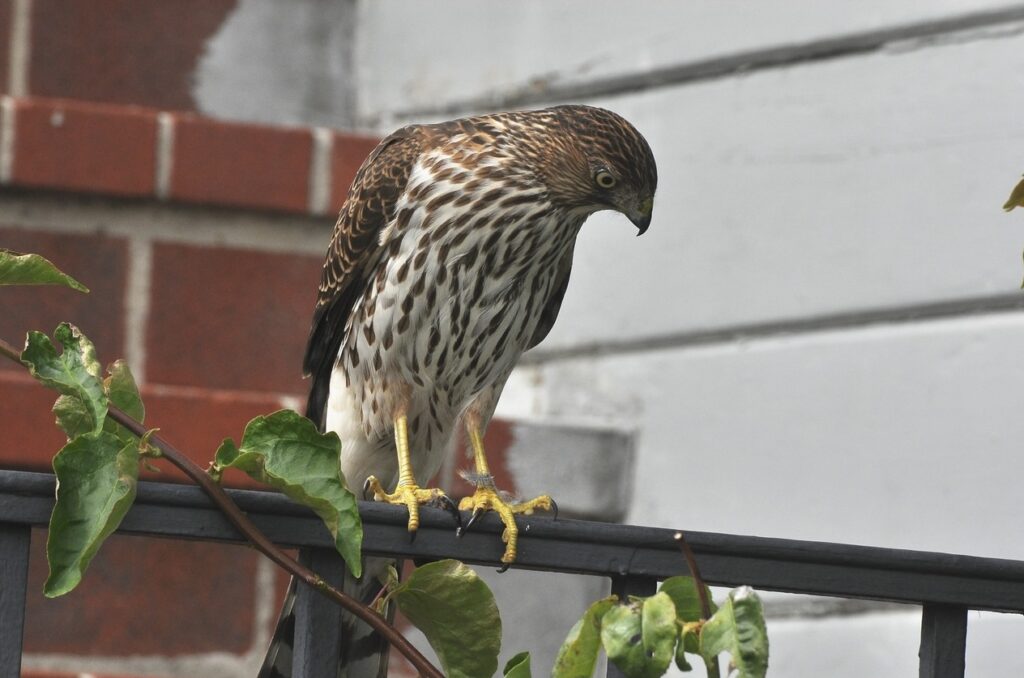
All through the study, I wondered: how did Cooper’s hawks go from being one of the hardest raptors to find when I was a Bay Area kid in the 1970s to being the quintessential urban raptor in the 2000s? Even by the time we started the Berkeley study, there were already well-published accounts of urban-nesting Coops in Milwaukee, Tucson, Victoria, Albuquerque, and Steven’s Point, Wisconsin—all thanks to incredibly dedicated raptor biologists in each of those cities. (Robert N. Rosenfield’s book The Cooper’s Hawk: breeding ecology & natural history of a winged huntsman is a great overview of the lives and biology of Cooper’s hawks by the most prolific Cooper’s hawk ecologist. Rosenfield has many important Cooper’s hawk articles findable on Google Scholar as well.)
For example, what were the Cooper’s hawks eating? Although Cooper’s and Sharp-shinned hawks are often referred to as bird-hawks, Cooper’s are more varied in their food types in California, with a breakdown more like 75% birds, 20% mammals, and 5% reptiles and insects (Raptors of California, Robert D. Mallette and Gordon I. Gould, Jr., 1976). The East Bay study reflected those percentages, with at least a few rats and mice showing up in our observations and prey remains.
Rat predation may have been a bigger problem than we originally imagined. In 2007, volunteer Lisa Owens Viani was notified that a pair of Cooper’s chicks from her search area had drowned in a child’s pool, immediately after fledging. Lisa arranged to have the hawk carcasses analyzed. Having barely fledged, they each carried a cocktail of rodenticides. This tragic event inspired Lisa to found Raptors Are The Solution.
I have no doubt that Cooper’s hawks have benefited from concentrations of bird prey in cities, particularly from backyard feeders and flocks of rock doves, aka city pigeons. During the first two years of the East Bay study, we collected and bagged more than 1,000 prey samples near hawk nests. Three species made up 63% of the total number: mourning dove, American robin, and rock pigeon. These three also comprised nearly 80% of the Cooper’s collective diet by weight (see Prey Selection of Cooper’s Hawks Nesting in Urban Areas of Berkeley and Albany, California, Aaron Haiman, 2006).
Of the 95 nests located throughout the study: 37% were in street trees, 25% in local city parks, and 22% on the UC Berkeley campus. Although we might have missed some nests in the denser, native-forest canyons, this result was a bit eye-opening: Cooper’s didn’t necessarily rely on small city parks, or the forest-rich UC Berkeley campus. More than 80% of the nest trees were only six species: Oregon ash, blue gum eucalyptus, American elm, Monterey pine, blackwood acacia, and coast live oak. Of these only the oak is truly native to the East Bay; all the others were planted as street or shelterbelt trees.
Although the true, pre-colonial East Bay was host to many spectacular native trees (coast redwood, Western sycamore, and valley oaks among them), the race to cut for firewood and building materials devastated these habitats well before 1900. Most of Berkeley was laid out, developed, and gridded with streets in the first half of the 20th century. This first generation of street trees, now 70-120 years old, have reached the height and volume to provide effective cover and structure for Cooper’s hawk nests. Moreover, many of these nest trees were along original East Bay creeks, with the higher water table creating better growth and foliage.
Many dynamics between the birds and landscape were in play in the East Bay study–as would be the case in any setting. For example, Cooper’s hawks nest throughout Tucson, AZ, but chick survival is reduced by an infection called Trichomoniasis (Identifying habitat sinks: a case study of Cooper’s hawks in an urban environment, R. W. Mannan et al., 2008). “Trich” is caused by the microorganism Trichomonas, which is prevalent in dove and pigeon populations. These birds form a large share of the Cooper’s hawk prey in Tucson.
Prey homogeneity is one of the downsides of urban raptor life, creating a higher likelihood of disease transmission. The same could be said for street trees. During the East Bay study, one of the neighborhoods was rocked by a Dutch elm disease outbreak. When many of 80-foot elms were cut down and chipped, a few hawk pairs long loyal to the area left for healthier forests.
How else do urban landscapes affect hawks? What if the effect is indirect—caused, for instance, by another bird species? I suspect that the flatter and more urban East Bay neighborhoods, with fewer parks and closer to the local interstate, might be more magnetic for Cooper’s hawks since they are less likely to harbor great horned owls. Although we call them predators, Cooper’s are sufficiently small to be prey in turn for great horned owls, and likely select nest locations to stay out of their way.
There’s also a lot to be said about urban zones as centers of heat, really as sources of their own weather conditions. In cities, the large amount of concrete, glass and metal, the many reflective surfaces, generate more heat than in a natural landscape, creating a kind of localized climate change. This was part of the problem during an unprecedented heat spell in July 2021 (Extreme heat triggers mass die-offs and stress for wildlife in the West, 2021), when dozens of heat-stressed Cooper’s hawks (and other species) in Seattle and Portland prematurely fledged from their nests, and wildlife rehabilitators were thrown into a frenzy. The downy hawk chicks were simply overheated by the extraordinary temperatures, and had no other options but to bolt from the nest.
From Obstacles to Opportunities
Not to get depressing, but for hawks, for all wildlife, there are many dangers, many ways to be injured or die in an urban landscape. No species evolved in a city; the best it can do is adapt to the unintended obstacles we’ve placed in its path. Think about encounters with power lines, electrocution, windows, cars and trucks. Cities offer raptors high chances of encountering toxics, such as rodenticides, heavy metals, and other poisons. Cities are by definition densely-populated human habitats with homogenous landscapes—this is an ecological set-up for the easy transmission of diseases for humans and non-humans alike.
But we know all this now. No one ever planned a city to benefit raptors, yet raptors are still choosing to nest in cities.
So—how can we use what we know to create urban spaces that create better survival chances for birds of prey? For wildlife in general? To make use of the ecological services that predators can provide, e.g. rat control?
It’s a time for optimism and thoughtful planning—not just for wildlife and the services they provide, but to create a better quality of life for all of us.
Of course, some people don’t see the bright light in all this. These are the words of an anonymous pest control expert on Nextdoor, quoted verbatim: “If left to snap traps and Wildlife alone, the rodents will retake the planet it is not a joke. Raptors are not the answer look at next door & see how many missing cats they’re already are if you think for one second that a raptor will not pick up a cat & eat it then you need to think again it happens all the time. We can’t have Hawks and Falcons flying around all over the city.”
We can’t? But why not? I have two thoughts. First off: open your eyes, anxious pest control guy. Raptors already live in cities all over the world. For decades now, hawks, falcons, owls, and even vultures have found an ecological niche provided by the human love for rivers and parks and trees in our cities, and by the human habit of leaving garbage and refuse around town. The latter provides food for scavengers, for whatever rats, pigeons, and other species “clean up” after us, and in turn creates a prey base for birds of prey.
No doubt some larger raptors have hunted some smaller domestic cats, but it doesn’t come close to the number of cats hit by cars annually (5 million+ in the United States). Or the number of songbirds eaten by cats in cities (1-4 billion birds in the United States).
Secondly, what is gained by having birds of prey in cities? I once got a phone call from someone who had just watched a golden eagle drift slowly past her office window in a San Francisco highrise, hundreds of feet above the city streets. Her joy, her excitement for seeing this bird, eye to eye, was uncontainable. I am positive she will never forget that five seconds of her life.

The sudden appearance of an eagle, hawk, or falcon is a huge event for most of us, whether in a city block or a wild landscape. These moments contain an emotional power, an exhilaration that is hard to classify. Long ago, in our human evolution, a large raptor in the sky also carried a very clear and compelling message: there is food nearby, not just for the hawk, but perhaps for us as well. So, I say, bring on the urban raptors. Let’s create cities that support them as well as possible. We, and the cities we live in, will be the healthier for it. (Watch for a followup article with my ideas for making cities more raptor-friendly!)
There’s a lot of work to do to support raptors in cities, but there’s also a rapidly growing international literature on the topic. Try searching on Google Scholar for “city” or “urban” plus any raptor species name. You might read about red kites in the UK, crested goshawks in Taipei, chimango caracaras in Santiago, and multiple vulture species in Senegal. It’s an exciting time to be able to learn about raptors in many places in the world. Thanks to the steps we took in the 1970s to ban DDT and other toxics, and steps we are taking in California and other places to crack down on rodenticides and other poisons, anyone might encounter a hawk or owl, even an eagle, in a city—and feel truly inspired.
Great thanks to my colleagues who contributed their observations and ideas regarding urban raptor ecology: Anne Ardillo, Don Bartling, Doug Bell, Ryan Bourbour, Tony Brake, Chris Carino, Deborah Crooks, John Davis, Ben Dudek, Teresa Ely, Zeka Glucs, David Gregoire, Keith Gress, Jim Hallisey, Eric Jepsen, Mary Kenney, Mary Malec, Breanna Martinico, Craig Nikitas, Becky Olsen, Lisa Owens Viani, Denise Peck, Ralph Pericoli, Bob Power, Siobhan Ruck, Erika Walther, Noreen Weeden, and Step Wilson.
Additional Reading
To learn more about the urban ecology of birds of prey, check out these resources:
- Raptors in Human Landscapes: Adaptations to built and cultivated environments (eds. David M Bird, Daniel E. Varland, and Juan Jose Negro, 1996)
- Urban Raptors: Ecology and Conservation of Birds of Prey in Cities (eds. Clint W. Boal and Cheryl R. Dykstra, 2018)
- “Costs and Benefits of Urban Living in Raptors” by Claudina Solaro, pp. 177-196 in Birds of Prey – Biology and conservation in the XXI Century (eds. José Hernán Sarasola, Juan Manuel Grande, and Juan José Negro, 2018)