
by Joe Eaton
(Full article from RATS Tales November 2025)
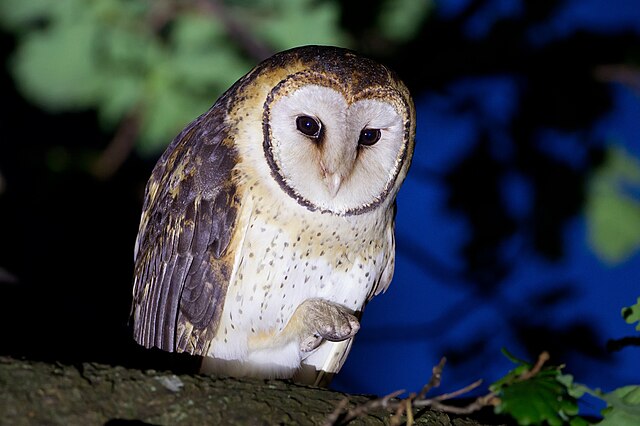
Australian scientists continue to report widespread exposure to anticoagulant rodenticides (ARs) in raptors, as well as mammals, reptiles, and amphibians.
Previous studies found ARs in Australian boobook owls in Western Australia and Victoria, powerful owls and eastern barn owls in Victoria, and wedge-tailed eagles in Tasmania. Now, one of a pair of newly published articles documents second-generation ARs (SGARs) in the endangered Tasmanian masked owl. The other article, covering multiple species of raptors in the northeastern state of Queensland, unexpectedly shows the first-generation AR (FGAR) warfarin to be more pervasive than any of the SGARs.
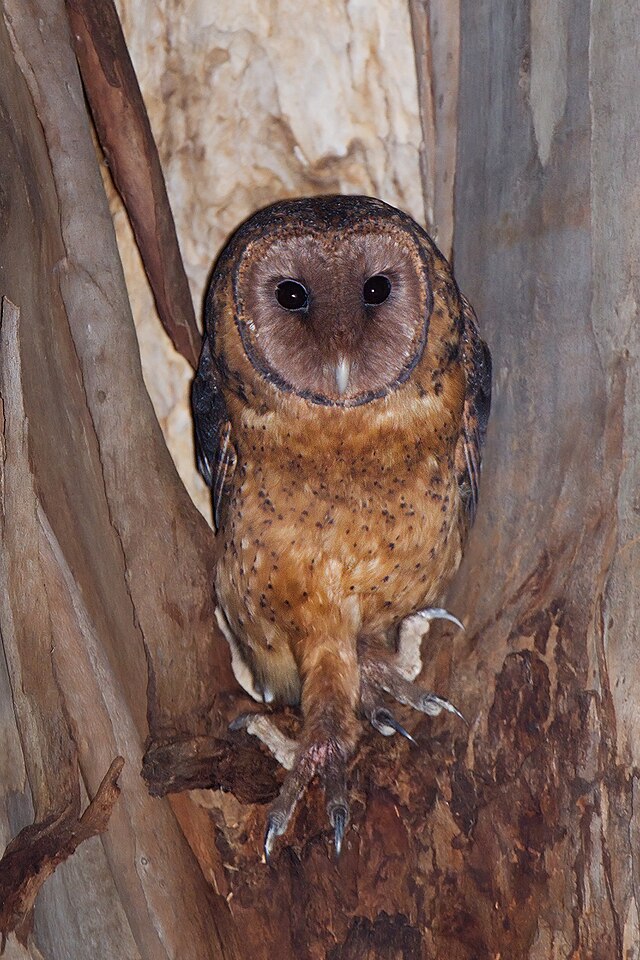
The first article, by Judy Clarke of the Tasmanian Museum and Art Gallery and multiple co-authors, appeared in the ornithological journal Emu. Its focal species, the Tasmanian masked owl, is a member of the barn owl family with a diet that includes rodents, rabbits, small marsupials, and birds. The most recent population estimate is about 200 nesting pairs, and the subspecies is listed as endangered under Tasmanian law and vulnerable under a national statute. Its habitat has been reduced by the destruction of old-growth forest.
Seventeen masked owl carcasses found in the island state between 2015 and 2023 were analyzed for FGAR and SGAR liver residues. SGARs were found in the livers of sixteen birds: brodifacoum in fifteen, bromadiolone (along with brodifacoum) in two, and difenacoum in one. The owl with difenacoum exposure also tested positive for pindone, an FGAR used primarily to kill rabbits. This aligns with an earlier study reporting SGARs in 85 percent of 20 Tasmanian masked owls. One owl had a lethal SGAR level, and all but one of the remaining sixteen had levels ranging from possibly toxic to possibly lethal.
Four owls in the sample had been killed in vehicle collisions, eight others by unspecified trauma. Clarke and her co-authors note that those deaths may have involved sublethal effects of AR poisoning. They cite studies suggesting that barn owls and their close relatives may be more sensitive to AR toxicity than other raptors.
In the second article, in the journal Discover Toxicology, Zachary Low of The University of Queensland and co- authors analyzed the remains of 24 birds of eleven species either found as roadkill or euthanized at the school’s Veterinary Teaching Hospital in 2022 and 2023. These included three owls (eastern barn owl, powerful owl, Australian boobook owl), seven diurnal raptors (wedge-tailed eagle, black- shouldered kite, black kite, gray goshawk, brown goshawk, peregrine falcon, Nankeen kestrel), and a non-raptor (tawny frogmouth) that feeds on rodents. Ten of the specimens were barn owls, with the other species represented by one to three individuals each.
AR residues were found in the livers of ten of the birds. The most frequently detected compound was the FGAR warfarin, in eleven samples. There were only a few instances of SGARs: brodifacoum in three birds, and difethialone and flocoumafen in one bird each. Three had been exposed to warfarin plus one of the SGARs. Concentrations were comparatively low; the highest was 0.64 milligrams per kilogram of warfarin in a wedge-tailed eagle.
The preponderance of warfarin is surprising. In most AR studies, in Australia and elsewhere, SGARs are much more common than FGARs. “BirdLife Australia has been campaigning strongly to get people back into using FGARs,” says co-author Viviana Gonzalez-Astudillo. “It would be interesting to do a survey and see what farmers and the general public are relying on for rodent control in our region.”
BirdLife Australia does list FGARs among other alternatives to SGARs on its website. However, endorsing FGARs as a lesser evil seems dubious. FGARs can also be damaging: Barnett Rattner’s experimental work with American kestrels demonstrated significant interactions between the two classes of ARs, and California recently placed a moratorium on the use of all ARs, including FGARs, due to their direct and cumulative impacts on wildlife.
As with the Tasmanian owls, traumatic injuries were present in most of the birds (fifteen). Sublethal effects may have contributed to their deaths, according to Low, et al.: “In wild birds, sublethal SGAR toxicosis has been shown to cause symptoms such as lethargy, reduced agility, and wing droop. These effects result in decreased fitness, impairing the birds’ ability to hunt and navigate their environment, increasing their risk of vehicular accidents.”
The authors mention the possibly greater susceptibility of barn owls because of “their relatively limited hepatic [liver] detoxification capacities relative to other avian species.” Comparing different groups of birds, they note that the two goshawks (related to the American goshawk, Cooper’s hawk, and sharp-shinned hawk) are bird predators, unlike the rodent-eating barn owls. However, other sources say the gray goshawk also hunts mammals including possums—some species of which have tested positive for SGARs—and rabbits. (SGARs have been detected in gray goshawks in Tasmania, but the data hasn’t been published yet.) Brown goshawks take young rabbits. Within a diverse group of raptors, multiple exposure pathways are likely.
The frogmouth, an improbable-looking bird related to the nightjars, is a special case. SGARs have also been found in tawny frogmouths in Victoria. The authors suggest the species may be more vulnerable than other birds because it accumulates fat reserves for winter, potentially increasing the bioaccumulation of SGARs. Gonzalez-Astudillo cautions that this is speculative so far.
Even as rodenticides permeate Australian food webs, impacting creatures from banjo frogs to Tasmanian devils, the Australian Pesticides and Veterinary Medicines Authority has not yet completed its long-awaited review of AR registration.