
Biologist Allen Fish walks the alphabet of raptor ecology…

“Raptor Ecology A to Z” is an eclectic introduction to birds of prey, a lexicon of topics that have fascinated and motivated me over the years. Each letter is a snippet of information that I hope will engage you to wonder, to look deeper, to ask more questions, and to just enjoy playing in a sandbox of ideas.
Find out a little more about me here.
Download a pdf of the entire book here.
Read more about raptors in cities.
We give huge thanks to the amazing photographers who donate so many wonderful photos in support of our work. For permission to use any photos, please contact us/the photographers via raptorsarethesolution@gmail.com
-
A
-
B
-
C
-
D
-
E
-
F
-
G
-
H
-
I&J
-
K
-
L&M
-
N
-
O
-
P
-
Q
-
R
-
S
-
T
-
U
-
V
-
W
-
X
-
Y
-
Z
•A•
ACCIPITER/ASTUR
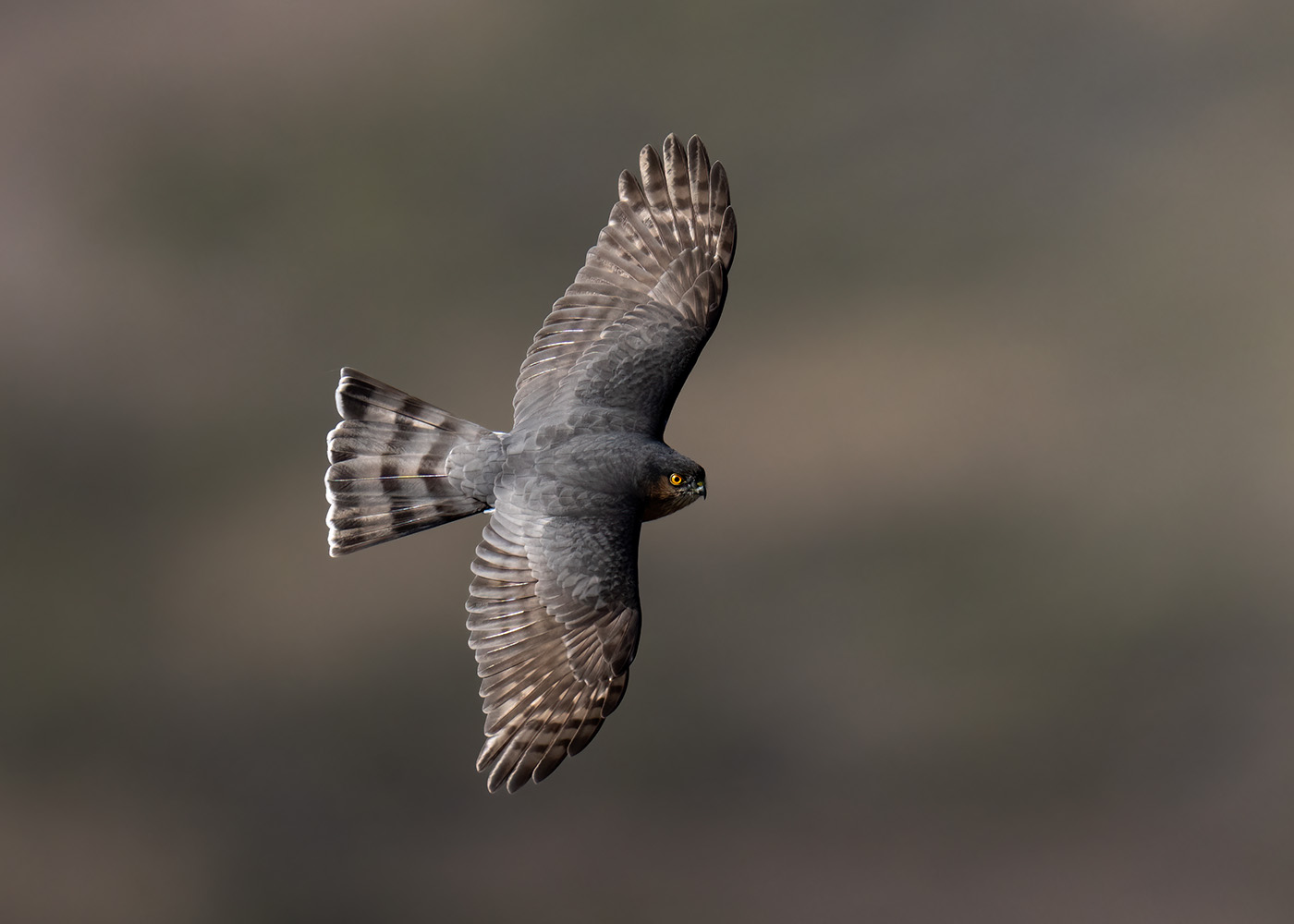
When a smallish, long-tailed, flappy hawk bursts through your backyard, silencing the songbirds, and you aren’t sure if it is a Cooper’s or sharp-shinned hawk, you might loudly declare “accipiter!” But in late 2024, the American Birding Association Check-list Committee, based on scientific analyses of species’ DNA relationships, announced that the genus Accipiter, once packed with 50+ global species, would be split into Astur (Cooper’s and American goshawk) and Accipiter (sharp-shinned hawk), perhaps with more splits in the future.
Two take-home messages here. First, although Cooper’s are often confused with sharpshins, Coopers are actually more closely related to the American goshawk. Said differently, a Cooper’s hawk is more a scaled-down goshawk than it is a hefty sharpshin. Second, what name will you yell out when the next ambiguous smallish forest-hawk clears your yard of winter juncos? Unidentifed Accipiter or Astur? Accipastur? Hmmm—these options are clunky, and none really fits the urgency of the moment. We might just have to see what evolves, and for now appreciate that we are learning more about raptor evolution and genetics.
 |
 |
|---|---|
| Cooper’s hawk (Dave Harper) | Sharp-shinned hawk (John Davis) |
•B•
BOOTED
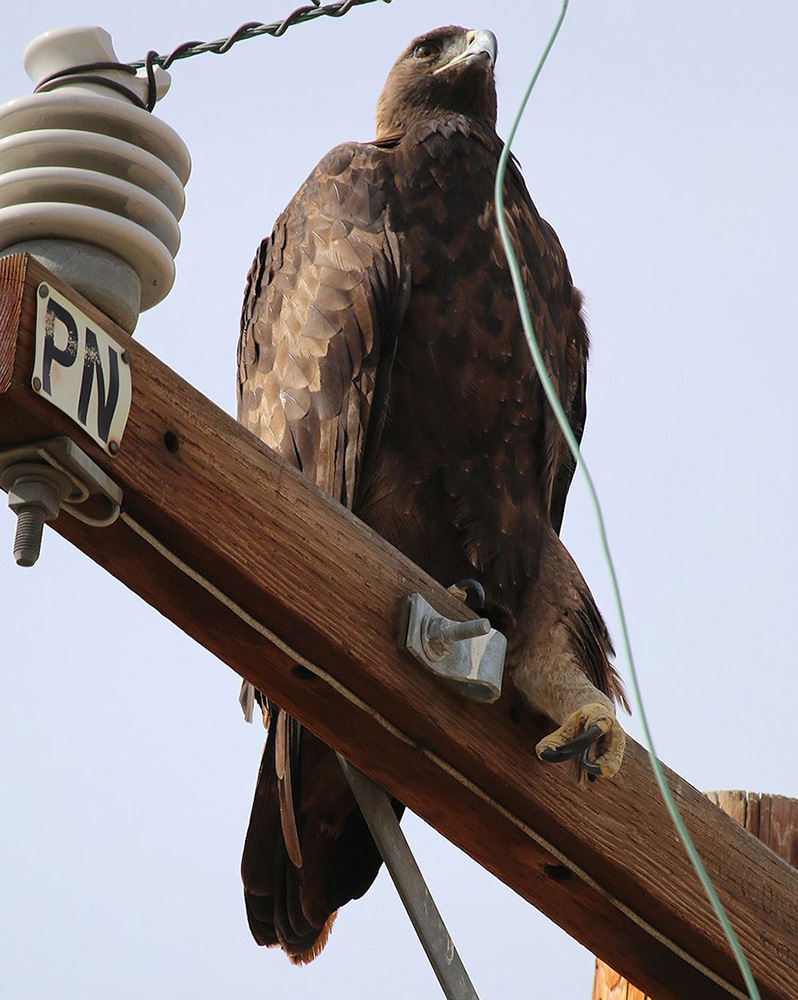
Booted is just what it sounds like—the feathering around the leg and ankle of a hawk or owl. (Uggs for birds!) But let’s think like an evolutionary ecologist—why do some raptors have boots (technically called “feathered tarsi”) while others do not? What are feathered legs good for?
Maybe we should think about Uggs—some Arctic hawks and owls have feathered legs that could be an effective defense against freezing temps; for example, the snowy owl and the rough-legged hawk. Biologists Estelle and Leon Kelso did a thorough analysis of owls back in 1936 to see how “bootedness” aligned with latitudes and ecosystems. They found more bare-legged species in tropical, subtropical, or temperate areas, usually humid and warm zones, and generally closer to the equator. Most heavily leg-feathered owls were from cold and Arctic environments.
The two North American eagle species are separated by their bootedness. Species in the genus Aquila, golden eagles among them, are informally called “booted eagles.” One prominent raptor taxonomist, Dean Amadon, has speculated that the golden’s feathered legs might be a little “added protection while grappling with dangerous prey.” Amadon was probably thinking about medium-sized terrestrial predators and large rodents, perhaps snakes. The bare-leg bald eagles are more focused on waterfowl and fish for sustenance, although both species take a wide range of prey.
 |
 |
|---|---|
| This golden eagle has extended its left leg so you can see its “boots”—the feathering all the way to the feet. (Dave Harper) | An adult red-shouldered hawk lowers its feet for stability or getting ready to perch, inadvertently showing its long “unbooted” legs, also called “bare tarsi.” (Joe Galkowski) |
•C•
COURTSHIP
Raptors are dazzling in their courtship displays. From simple bill-clacking and vocal duets, to gravity-defying loop-the-loop dances, raptor courtship behaviors are known to stimulate the birds’ hormones, causing gonadal growth, and generally synching female and male for the reproductive process ahead. Some displays are so athletic—a high-flying male harrier drops a mouse in the sky to be caught mid-air dozens of feet below by the expert talons of the female—that they seem to be a proxy for each raptor’s health and even hunting prowess.
Many species groups have their own characteristic displays. Accipiters fly wide circles using an exaggerated flap that looks weirdly moth-like. Many buteos (soaring hawks) and eagles perform long undulating flights that rise and fall for a quarter mile across the sky. Many eagles, as well as some kites and buteos, grasp talons in mid-air and spin. Known as cartwheeling or talon-grappling, this behavior is breathtaking to watch. However, at least one bald eagle pair did not uncouple before they hit the ground and died. Indeed, romance can be as dangerous for birds as for primates.
 |
|---|
| Many raptors incorporate a prey exchange into their courtship flights, which helps both to synchronize the pair’s physiological processes, and to show the male’s hunting ability, as in the case of this peregrine pair. (Don Bartling) |
•D•
DIMORPHISM
Dimorphism means “two forms” and refers to some general pattern of the sexes being different looking. This could be about size, coloration, or other features, but for here, we’ll focus on size dimorphism, since female raptors are nearly always bigger than males.
Small males and large females are found across a wide range of vertebrates and invertebrates. Consider spiders and hyenas, whales and mantids. In more than 80% of fish species and 66% of snakes, females grow to a bigger size than males within the species. Why should this pattern exist for raptors? And why are some raptor sexes similarly-sized, like vultures, while others are hugely different?
Hundreds of scientific papers have been written on the evolutionary reasons for sexual size dimorphism in raptors. Here are a few: (1) large females lay large eggs (i.e., well-developed chicks), which reduces the time from laying to fledging—the riskiest life phase for most raptors; (2) large females are better nest- and nestling-defenders; (3) small males are more efficient hunters and thus nest-providers; and (4) the female-male size-split allows each sex to specialize in different-sized prey. In other words, they can share the larder more efficiently.
Another intriguing pattern: raptors that specialize in pursuing fast and maneuverable prey (think birds and bats) show greater size differences between the sexes. For example, many male Accipiters (mostly bird-predators) are 53-80% the weight of the female, with sharp-shinned hawks being among the smallest at 54%. Perch-hunting and soaring raptors (mostly small mammal- and herp-hunters) tend to be less size-dimorphic. Male buteos are 73-91% of the female weight on average; male aquila eagles about 81-96%. Falcons mostly range from 73 to 80%; however some of the bat- and bird-specialist falcons, like the Barbary, gray, bat, and orange-breasted falcons are in the mid 60%.
 |
|---|
| Northern spotted owls showing larger female in foreground (Carlos Porrata) |
•E•
EYRIE
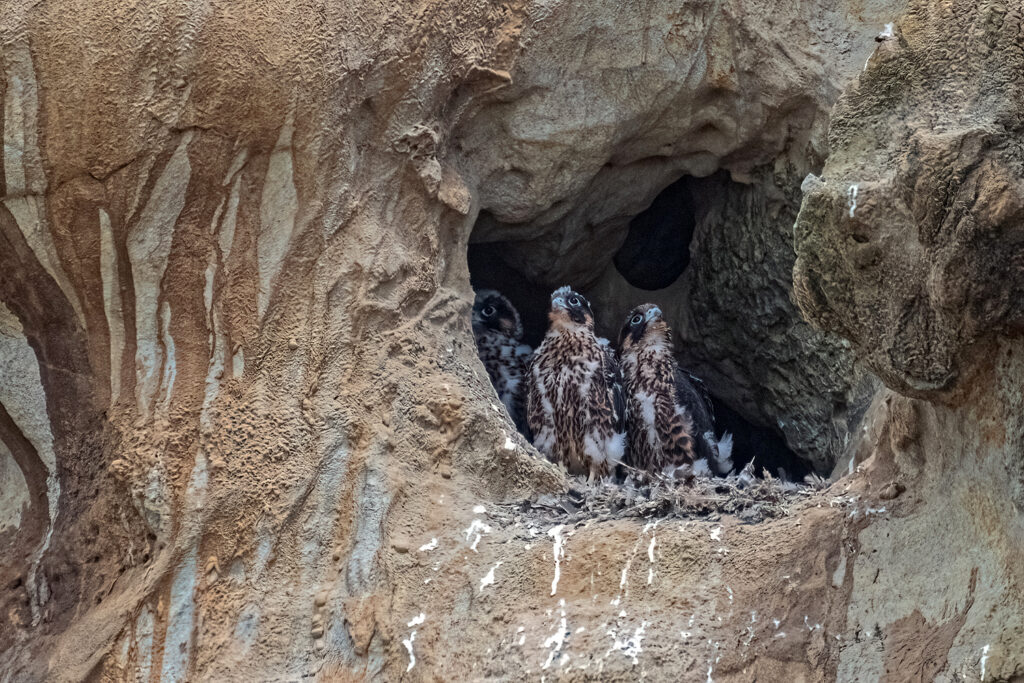
An eyrie or aerie (pronounced “EYE-ree”) is a bird of prey nest placed on a cliff or rock face, in a small cave, or atop a rocky outcropping. To make sense of eyries it helps to know this fact: neither owls nor falcons build nests. The many different falcon species have different strategies for safe placement of their eggs. Kestrels use cavities in old trees or buildings—or next boxes. Merlins often borrow old stick nests from crows or ravens. And many bigger falcons, like peregrines, build a nesting territory on a cliff or manmade structure with just the right location and substrate to create a shallow sand or gravel bowl to contain the eggs. These cliff sites are eyries.
Many owls nest in or on cliffs as well. Great horned and barn owls may be found nesting in pockets in rock faces above Tulelake National Wildlife Refuge within 100 feet of a prairie falcon nest. But eyries aren’t just about owls and falcons. Vultures and condors also place their clutches in small caves in cliffs. The nests of eagles and large hawks, sometimes elaborate constructions of sticks and other objects, are called eyries if placed on a rocky ledge or pocket.
 |
|---|
| Eyries, like this peregrine falcon nest, can be an important nest defense strategy for deterring predators like raccoons, bobcats, and foxes. (Carlos Poratta) |
•F•
FLEDGING/FLEDGLING
Popular media tends to depict fledging as a one-time event in a bird’s life, as when a young wood duck leaps from a tree cavity into a gentle pond. Boom—job done! But in raptors, fledging may take days as a vulnerable, not-fully-feathered raptor newbie leaves the nest or eyrie and figures out the business of flying.
Whether fledging from a tree or cliff, hawks, falcons, and owls tend to first make short jaunts away from the nest, stepping and climbing at first, but progressively leaping, walking, wing-flapping, and even running. Young pre-flying Cooper’s hawks move out onto tree limbs as “branchers” until the precise moment that a parent delivers a dove carcass to the nest, whereupon five uncoordinated but hungry fledgling hawks run, leap, and fly back to the nest ASAP as if pulled by the world’s strongest magnet. This food-reward system progresses until eventually the parent is coaxing a fledgling into full flight with bits of food.
As long as you see things from a distance so the parents don’t get tense, the fledging period is one of the most compelling times for watching raptor behaviors. The many trips, slips, fights, head-bobs, insect-grabs, tail-pulls, and other antics will make you wonder how, in just a month or two, these slapstick nestlings become the so-graceful, flying versions of themselves.
 |
|---|
| Great horned owl fledglings can spend weeks in the branches and even on the ground near the nest, all while still being tended by parent birds. They’re also excellent climbers, and can use their feet and beaks to climb up into trees. (Pamela Rose Hawken) |
•G•
GLIDING/SOARING/STOOPING
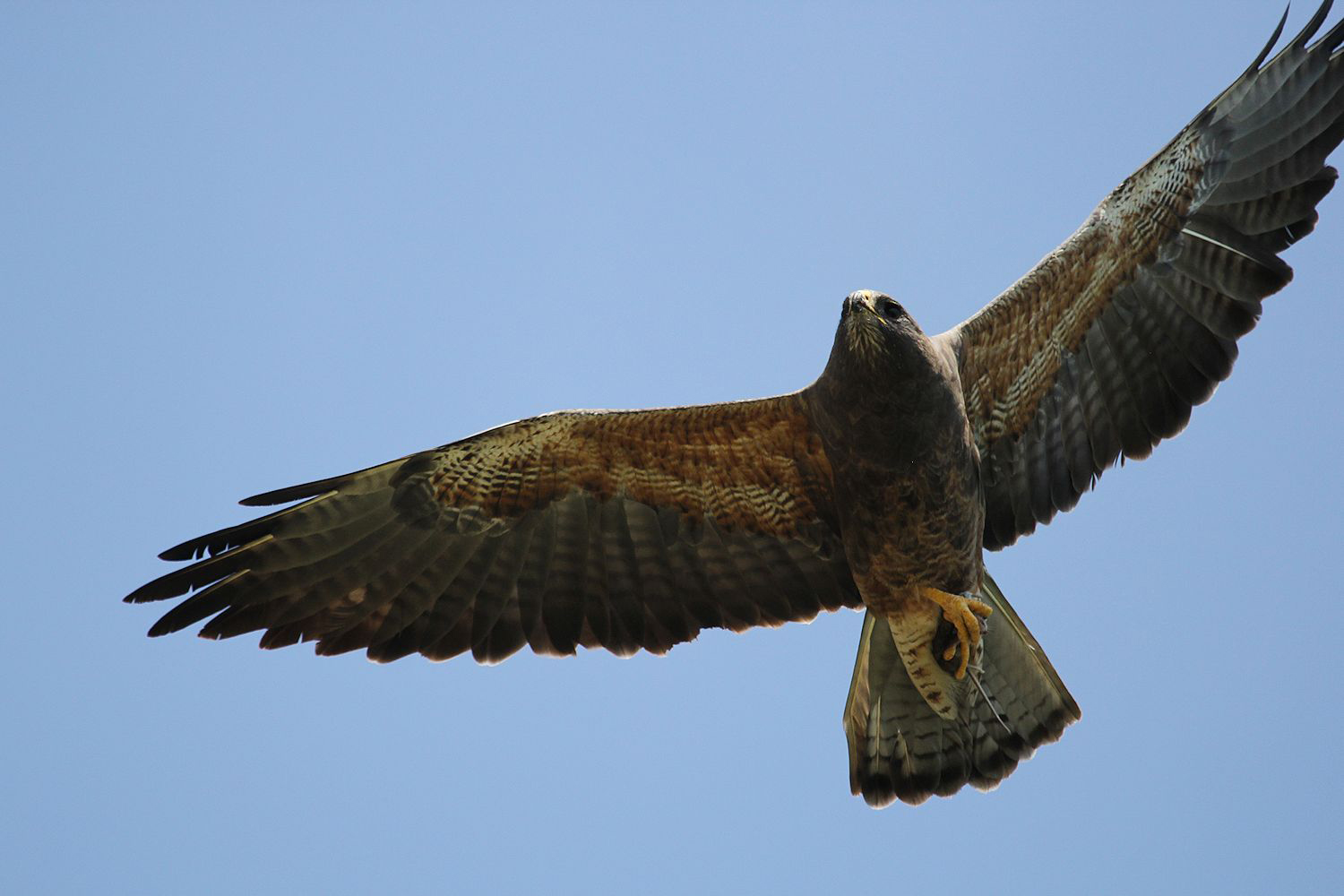
At a simple level, gliding is flying on stiff wings and descending, while soaring is flying on stiff wings and ascending. But what exactly is the raptor doing with its wings and tail to glide or soar? A gliding hawk must reduce its surface area by partially folding her wings and tail to “spill” air out from underneath, and thereby lose altitude. A soaring hawk does the opposite. It becomes an umbrella, maximizing its surface area by fully expanding wings and tail to capture rising air underneath, and allowing her to lift.
“Stooping” is a glide with intention, a steep glide. The bird seriously reduces her surface area by folding her wings nearly against her body, and collapses her tail to the width of two tail feathers. What’s her intention? Could be life (getting food) or death (avoiding becoming food). Peregrines are known to enact stoops to attack a prey bird in flight, but other falcons, hawks, and especially eagles manage some spectacular stoops as well—sometimes as part of a courtship display.
A colleague recently told me about watching an osprey alternate stooping then rising at great angles, all while carrying a large fish. This courtship display—called porpoising—shows up in many hawks and eagles, and the upward parts are usually on pulled-in wings so in this case, the osprey’s momentum allows it to briefly glide upwards!
 |
 |
|---|---|
| Northern harrier on a downflap (Pamela Rose Hawken) | This rodent-toting, dark-morph Swainson’s hawk has its wing and tail feathers fully expanded, thereby maximizing its surface area to catch a thermal, also known as soaring. (Dave Harper) |
•H•
HABITATS/HARRIERS
As you become an active birder, you will start to notice something: many bird species only show up in specific habitats. You can almost predict what bird you will find in what habitat. A good example are the harriers in genus Circus. Found around the planet with 13+ species, harriers consistently live and hunt in flat, open areas, ranging from wet to dry. Harrier habitat can be marshes, wetlands, bogs, plains, moorlands, meadows, tundra, savannah, scrub, steppe, desert washes, rice-fields, hayfields, and other flattish agricultural areas. Harriers are habitat-specialists—they like unforested, open areas, fields with short vegetation.
So, what raptor species is a habitat-generalist? In North America, red-tailed hawks are found in a huge variety of habitat types, from tall forest edges to desert cliffs to rural and even urban landscapes. As you get to know the raptor species of a new place, try to learn their preferred habitat(s) as well. And even better, notice how a raptor species’ habitat preference is tied to its hunting style, its morphology, and its prey preferences. All of these aspects are contained in the species’ ecological niche—its essential role in the ecosystem.
Back to harriers. Harriers are generalist predators, often feeding on mice, but also small to medium birds, herps, and large insects. However, they do have a specialized hunting style—they harry. They glide low, within ten feet or so of the ground, with an occasional flap, and keep their ears and eyes focused on the vegetation below, ahead, and to the sides. Like owls, harriers have a facial disc, a near-circle of stiffened feathers around the face that effectively concentrates sound back to the ears. Because their hearing is so acute, harriers are able to hunt in tall grasslands, which would thwart the best efforts of, say, a redtail.
 |
 |
|---|---|
| This male northern harrier told by its gray plumage, prefers to sit on a low bush lupine just a few feet off the ground. No forest required. (Pamela Rose Hawken) | Northern harriers are happiest perching and hunting near terra firma. This juvenile’s orange breast color blends into the mid-summer marsh landscapes. (Pamela Rose Hawken) |
•I&J•
IMMATURE/JUVENILE
Raptor ages can be tricky, but many bird of prey plumages can be told as either juvenile—the first year of life—or adult—the second year of life—unless that particular species takes more than a year to reach adult plumage. Wait, what? Let’s start again: many raptor species change from juvenile to adult plumage during the first full molt at about one year of age. The molt is gradual and takes some number of weeks or months, which allows the hawk or owl to maintain flight ability throughout, but also gradual because new feathers are expensive. The cost? Protein. Which is why many bird species molt during the growing season when the most food is available.
Back to raptor ages. Some large raptors, generally eagles and big soaring hawks, take more than a year to reach their adult plumage. In bald eagles, that iconic white head and tail, brown body, and lemon-yellow bill is a (minimum) five-year old adult eagle. Younger bald eagles from years one to four, go through a series of partial molts that each look quite different from that iconic adult plumage.
Most owls and many hawks reach adult plumage in one year, so those under one-year-old birds are called juveniles. But many larger hawks and eagles take more than a year to reach adult plumage, so they are called juveniles in their first year of life, and later called subadult during the subsequent, pre-adult years. Immature is the term used for any non-adult plumages, so for a small raptor like a sharp-shinned hawk, the juvenile and immature plumages are the same. For a bald eagle, immature equals the collective juvenile and subadult years. Essentially immature is not a very precise term, and is rarely used.
Why care about these nitpicking age terms at all? Because for many raptors, the juvenile and adult plumages can be wildly different, so to identify the species, you must learn the field-marks for both ages. A red-tailed hawk doesn’t get its signature brick-orange tail until the hawk is past its first year of age. The more camouflage-colored juveniles have grey-brown banded tails, and you might not know they are redtails without knowing some other redtail field-marks.
 |
|---|
| Juvenile plumages, like on this Cooper’s hawk, are often more brownish and mottled than their adult counterparts, presumably to be more camouflaged from potential predators. (Walter Keenan) |
•K•
KITES
Kites are flying tools that employ air-foil physics to lift strings, surfboards, and humans into the air. But kites are also raptors, though the term “kite” has been used generously over the last few hundred years for species that we now know have little genetic connectivity. It’s easy to imagine early taxonomists saying “Heck, that’s a weird raptor. Let’s call it a kite!”
But bird names and relationships are always being refined by new and fascinating genetic research. Today, the most recent studies document 23 to 25 worldwide species of kites, grouped under 13 genera, and generally grouped under four subfamilies: Perninae, Milvinae, Elaninae, and Buteoninae. All are in the huge raptor family Accipitridae, which includes hawks, eagles, harriers, and many other species.
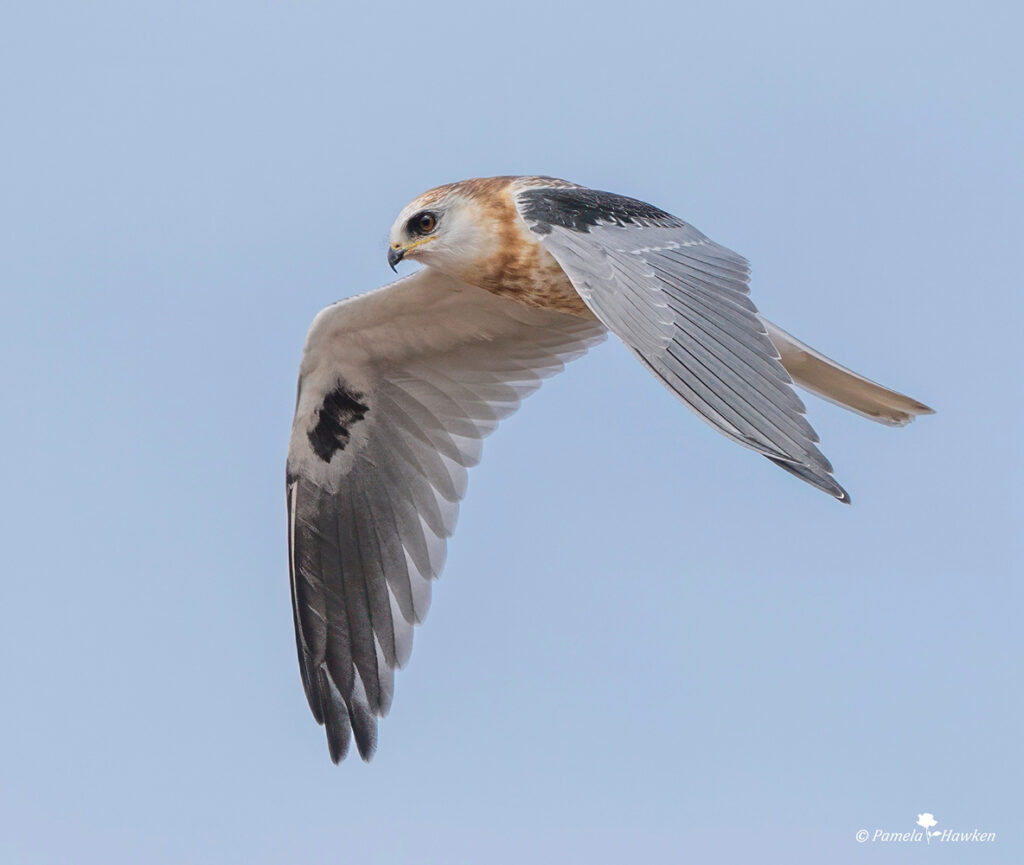
But the diversity of kites is spectacular. In the Americas, we have the nomadic mouse-focused white-tailed kite; the prey specialist snail kite of tropical lagoons and wetlands; the double-toothed kite, a solitary and mysterious forest hunter of lizards and large bugs; and the highly-migratory Mississippi kite, which gathers in flocks to fly 2,000 miles in a single autumn. In Europe, Asia, and Africa, the black kite is an extraordinary prey-generalist, capable of fishing like an osprey, carrion-feeding like a vulture, and taking a range of small terrestrial and avian prey. Some call the black kite the most numerous raptor in the world.
 |
|---|
| The white-tailed kite of the Americas is part of a worldwide genus, Elanus, which has been called “the better mousetrap.” (Pamela Rose Hawken) |
•L&M•
LIFESPAN/LONGEVITY
MORTALITY
The lifespan of a wild raptor is one of the most difficult pieces of data to obtain. Imagine the challenge: you must be able to recognize an individual through unique behaviors, field-marks or marker like color-bands. How do you keep track of its location, summer or winter? You wait around for years, but how do you know when it dies? Indeed, studies that produce any bits of lifespan data often take decades of work, and are incredible labors of conservation love.
Lifespan itself needs greater definition to be measured. The average lifespan is much lower than maximum lifespan, especially given the high rates of mortality in the first year of a raptor’s life. Sarah Kane published a fascinating analysis* drawn from a 40-year study of Swainson’s hawks in California near the Oregon border, using 279 individually identifiable birds, told apart by color-bands placed on their legs as nestlings. The average lifespan was 9.2 years (9.0 for females, 9.7 for males), while the maximum lifespan was 26 years. As simple as those data are, the four-decade study required tens of thousands of hours of work to accomplish.
So what are the mortality rates for each year of a raptor’s life? What are the chances that a hawk will die in its first, second year, or later? Ecologist Ian Newton assembled a table of mortality rates for a range of hawk, eagle, falcon, and kite species in Population Ecology of Raptors. Using more than 20 studies, the average first-year mortality rate was 64.5% (with a range of 51 to 74%); for the second year, 35.8% (30 to 47%); and for all later years, 32.6% (18 to 50%).
Numbers aside, what does all this mean for the lives of raptors? The message for me is this: the first year is really tough out there. Young hawks and owls make a lot of mistakes learning to use the much ballyhooed talons and hooked bills that define them as raptors. And regardless of their age, how do raptors die? By starvation, disease, parasites, and even predation. Toss in some human-caused stresses—poisoning by heavy metals or rodenticides; shooting and trapping; collisions with wires, windows, and cars; loss of natural habitats; just the sheer numbers of humans and human activities, and the holy grail of impacts, human-caused climate change—and the thousand points of impact on raptors and all natural systems are enormous.
*Kane, SA, et al. 2020. Age distribution and longevity in a breeding population of Swainson’s hawks Buteo swainsoni. Journal of Ornithology 161: 885-891
 |
 |
|---|---|
| On average, a first-year hawk, like this Swainson’s, has twice the likelihood of dying as its adult counterpart. (Dave Harper) | Adult Swainson’s hawk (Dave Harper) |
•N•
NATAL DISPERSAL
Natal dispersal is the movement from the nest or eyrie that the bird fledged from, to the first location where that same bird nests. Natal dispersal can also be measured as the straight-line distance from the nest to the first place of breeding. Why should we care about this? Because the pattern of natal dispersal helps us understand the genetic structure in a population. Eg, is there a lot of inbreeding, because most fledgers stay close to home? And isn’t inbreeding bad for genetics? Or is there a lot of outbreeding?
For many bird species, as mobile as birds are, inbreeding and outbreeding are often happening simultaneously. This results in a kind of balance of best results: inbreeding supports local adaptations for a particular habitat or prey type; outbreeding mixes genes on a wider geographic scale for greater genetic stability.
What’s intriguing about this for raptors, for all birds really, is that natal dispersal distances seem to be entirely connected to sex—males stay close to the natal territory, females travel far. By having the gene(s) that dictates dispersal distance hooked to the sex, there is an automatic system for balancing inbreeding and outbreeding in the population.
A 40-year Swainson’s hawk study on the California-Oregon border has produced some fascinating results regarding many aspects of Swain population ecology, including natal dispersal*. Of 117 chicks banded, 71 males showed natal dispersal distances of 0.1 to 28.0 km, with a mean of 8.3 + 0.7 km. Forty-six females showed a range of 0.2 to 46.0 km, and a mean of 11.1 + 1.1 km. Imagine being the raptor biologist—what kind of time and effort would it take to search 50 km in every direction from dozens of nests? And for many raptor species, the year of first-breeding is the third year of life, sometimes the fourth or fifth; natal dispersal research takes a lot of diligence, time, and money!
*Briggs, CW, et al. 2012. Correlates and fitness consequences of natal dispersal in Swainson’s Hawks. Condor 114: 764-770.
 |
|---|
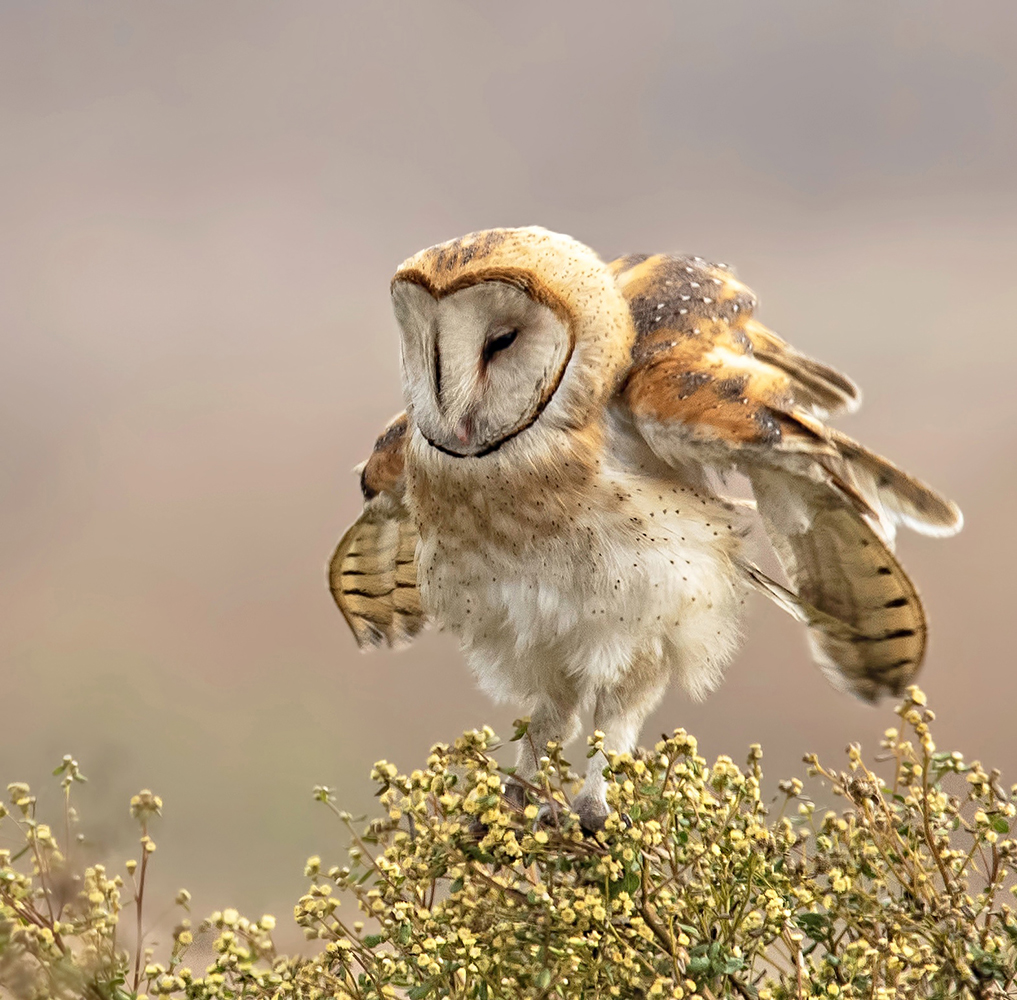
| A young barn owl learns to fly in days and weeks, although in the months-long process of dispersing from the natal territory, it must learn to find enough prey while not being preyed upon itself. (Pamela Rose Hawken) |
•O•
OLFACTION
Raptor smell has long fascinated biologists. Even Audubon did research on vulture smell ability, and even today, the controversies about who detects the rotting meat and who follows the smeller to the meat, still abound. Turkey vultures have keen olfaction abilities. They have large olfactory bulbs in the skull and nostrils open on both sides, and no one has shown this species’ smelling skills more clearly than David Houston* in the tropical forests of Panama.
In the 1980s, Houston placed recently-killed chicken carcasses on the forest floor, some covered by leaves, some not, and studied vulture response over subsequent days. Of 24 day-old carcasses placed, vultures located 80% within the first 12 hours. Of 74 total carcasses, 71 were found (96%) within three days. Covered baits were found just as quickly as uncovered, suggesting that no visual clues were used to locate the chickens. Since then, other field studies have offered evidence for olfactory abilities in the other two Cathartes vultures, lesser and greater yellow-headed, as well.
Simon Potier** reviewed the 2019 state of knowledge of raptor olfaction, an engaging journey through many behavioral and morphological studies. Other bird families also have proportionally large olfactory bulbs, suggesting that smell has a critical value for ducks, waders, seabirds, nighthawks, swifts, owls, and cuckoos. What might that value be? Navigation for one. Biologists have shown that shearwaters and albatrosses may use “odor maps” to find their way across immense expanses of ocean. Wow.
Status is another. Studying black kites, Potier himself showed that individual birds have unique signature chemicals emitting from their preen gland, chemicals that may confer breeding status or social dominance or—who knows? The bottom line: as is often the case in bird behavior, we are wonderfully naïve about the possible uses of smell in raptors, assuring that there are critical tasks ahead for students of raptor ecology.
*Houston, DC. 1986. Scavenging efficiency of turkey vultures in tropical forest. Condor 88: 318-323.
**Potier, S. 2019. Olfaction in raptors. Zoological Journal of the Linnean Society 189: 713-721.
 |
|---|
| The vulture’s open nares are called a perforated nostril. Someone once wrote: “you can watch the sun set through the nose of a turkey vulture.” (Pamela Rose Hawken) |
•P•
POLYGAMY
A surprisingly common question at raptor class is: “Raptors mate for life, right?” As much as this idea fascinates people, it’s very hard to study, and there are very little data on it. I think the more compelling question is: How would you show mating-for-life? Raptor lifetimes, even for smaller hawks or falcons, might be a decade or more, and for that whole duration you would have to be able to identify individual adults to be sure that this male was the same guy you last saw a day or week, or the year, before.
To recognize an individual bird, you (an experienced raptor biologist with proper governmental banding permits) might use color-bands, a brightly-colored band placed on the opposite leg as the familiar aluminum bird-band. Raptor color-bands usually have large alphanumeric digits on them (e.g., C5) so that many different birds can be marked and tracked. These permits and data are all regulated by the federal Bird Banding Lab for the U.S., and by state agencies as well, and by government agencies in many countries.
In 1960, pioneering raptor ecologist Dr. Fran Hamerstrom set out to answer this “mate for life” question for northern harriers on a 16,000-hectare marsh in central Wisconsin. From 1960-1983, Hamerstrom and her team color-banded 220 adult harriers so they could be identified from 100s of feet away. Her conclusions from observing 330 harrier matings over 24 years? First, harriers did not mate for life. In fact, they rarely re-mated in a second year. But far more interesting was the unintended result. The number of harrier nests each year was directly correlated with the abundance of voles that her team trapped in the marsh, and in the highest vole years, some of the harriers formed bigamist and even trigamist nests (35 of 330).
The details of Hamerstrom’s study are fascinating,* and over the last 40 years with better color-banding, genetic sleuthing, and more open minds, a range of raptor researchers have shown that a wide range of hawks, falcons, and owls can be occasionally polygynous or polyandrous.
*Hamerstrom, F., et al.1985. Effect of voles on mating systems in a central Wisconsin population of harriers. Wilson Bulletin 97: 332-346.
Hamerstrom, F. 1986. Harrier, Hawk of the Marshes. Smithsonian Books.
 |
|---|
| This adult female northern harrier attempts to pick a bouquet of yellow bush lupine for its mate. (Pamela Rose Hawken) |
•Q•
AQUILA
Aquila (ah-KEE-la) is a genus of large, booted eagles with one species or more found on most continents. The golden eagle (Aquila chrysaetos) is the most widespread of the 11 species, itself ranging from California to Kamchatka, i.e., from North America to Eurasia, but also south into North Africa as well. The most restricted (and rare) Aquila—the Spanish imperial eagle (A. adalberti)—is contained in Spain and Portugal, with somewhere around 1,000 individual birds left.
Knowing genera (plural of genus) like Aquila—but also Accipiter, Buteo, Circus, and Falco—is helpful to learn to identify birds, but there’s another reason to press these Latin names into your brain. Genera demonstrate evolutionary connectivity between species around the planet. For example, the two Aquila species mentioned above are more closely related to each other than either is to a ferruginous hawk (Buteo regalis), even though the latter is quite eagle-like.
When many bird species were first named in the 18th and 19th centuries, the names reflected external similarities between species, such as overall shape, morphology, and plumage, sometimes even behaviors and preferred habitats. In the last century, biologists have also used genetic characteristics to show close (or distant) evolutionary relationships between species. Because of this new information, taxonomists (biologists who study species relationships) sometimes propose new genus or species names for a particular bird. This re-naming sometimes seems arbitrary and even irritating to us when we have worked so hard to memorize a soon-to-be “old” name, but isn’t it more exciting to expose and regard the actual, true trajectories of species evolution? To see science in action?
In 2017, geneticist-taxonomist Heather Lerner, in cooperation with many others, published a fascinating analysis and classification of the world’s booted eagles. Lerner and colleagues* proposed a new phylogeny (like a species family tree) for 38 eagle species including Aquila, but they also offer up the still-confusing bits, a guide for the next generation of researchers.
*Lerner, HRL. 2017. Phylogeny and new taxonomy of the booted eagles (Accipitriformes: Aquilinae). Zootaxa 4216: 301-320.
 |
|---|
| Aquila eagles, like this golden eagle, include 11 species (more or less) found around the planet. (Dave Harper) |
•R•
RADIOTELEMETRY
You might not think of raptor mobility as a problem, unless of course you are studying hawks or owls and you want to know where that bird travels during the course of a year. Is it a long- or short-distance migrant? Is it a sedentary species making occasional forays away and back? Does it travel toward prey outbreaks, perhaps in groups (nomadism), or as a single (irruption)? How far from the nest does each parent travel for hunting? How far and when do the young disperse from the natal territory? Raptor movements are a surprisingly complicated series of behaviors, so how would you, the student, keep up?
Tracking flying birds of prey is indeed a huge challenge for slow-moving primates, but over the last 60 years, nearly each decade has offered some brilliant technological break-through. Known for their pioneering studies of raptor ecology in the 1940s, brothers John and Frank Craighead did some of the earliest radiotracking work on wildlife in the late 1950s, but switched their focus from hawks to grizzly bears. This made sense since the earliest radio-transmitters were heavy things, not too workable for birds of prey.
By the 1960s-70s, researchers were placing radio-transmitters on eagles, and tracking with a receiver and antenna, either by foot, car, or airplane. But still there were limits. For an average-sized raptor and transmitter, a signal might reach only 10-20 miles line-of-sight at best. By law and by ethics, a radio-transmitter can’t be more than 3% of the bird’s body weight, and the lightest trackers are around 20-grams. That means that you cannot effectively radio-track raptors smaller than 700-grams, such as sharp-shinned hawks, American kestrels, screech-owls, and burrowing owls. These species will need another technological breakthrough.
 |
 |
|---|---|
| A grizzly bear (Joe Galkowski) is heavy enough to carry most radio-transmitters; an American Kestrel (Pamela Rose Hawken) is not. | |
•S•
SATELLITE TRACKING
Since accurate satellite data became widely available in the early 2000s, satellite telemetry has given biologists a far-reaching tool to see deeper into raptors’ movements and lives. Using GPS and Argos systems, a satellite-transmitter can provide specific location data at selected time intervals, from mere minutes to many days. Raptor biologists can measure territory size, juvenile dispersal distances, and adult migration routes. Satellite tracking data have also been used to investigate habitat use, foraging behaviors, weather effects, and the even the speed and altitude of flights.
A satellite-transmitter, plus a mini-battery and/or solar panel, and antenna, can be reduced to 20-35 grams for use with large birds of prey. Some devices can be made smaller, allowing for use on birds less than 500 grams like small accipiters, falcons, and forest owls, but the battery life is usually sacrificed, meaning either the study stops early or a solar battery must be used. Transmitters are expensive, upwards of $2,000 per bird, which is ten times the cost of a radio-transmitter. But the advantage is clear—you can collect data from your office, saving a lot of gas money by not driving right behind the bird for 100s of miles or more.
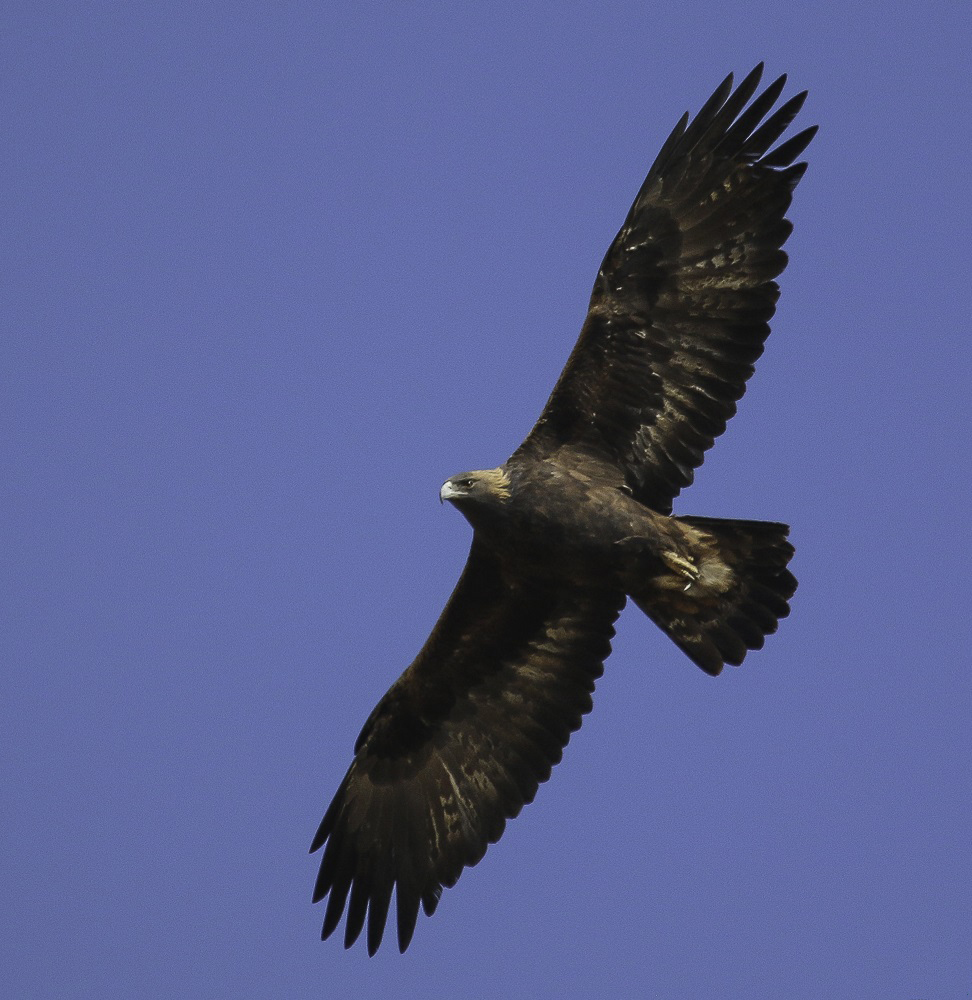
Satellite-tracking studies have documented magnificent and often international migrations of raptors, especially for vultures and condors, eagles, and Bubo owls. One great example: In 1997-1999, Carol McIntyre and colleagues* tracked 43 juvenile golden eagles away from their nesting territories at Denali National Park, documenting their first year’s flights. Using a backpack-style satellite transmitter plus battery and antenna weighing 95 grams (roughly 2% average body weight), they obtained more than 12,000 location data points.
The Denali study is well worth a read as McIntyre uncovers many facets of golden eagle migration such as: sex biases in flight distances, the hour-by-hour timing of daily flights, and how many days for mid-migration rest stops (stopovers). The peak one-day flight distances for fall migrating eagles averaged 180 miles. And distances from Alaska nest-sites to winter sites ranged from 500 to 3,000 miles, with juvenile eagles reaching Washington, Idaho, Colorado, and even New Mexico!
For a deeper dive into raptor (and wildlife) telemetry, peruse the website for Cellular Tracking Technologies, a cutting-edge radio and satellite-tracking business based in New Jersey.
*McIntyre, C, et al. 2008. Movements of golden eagles (Aquila chrysaetos) from interior Alaska during their first year of independence. The Auk 125: 214-224.
 |
|---|
| Golden eagles from Alaska have been satellite-tracked as far away as New Mexico. (Dave Harper) |
•T•
TALONS
Talons are a defining feature of raptors, the curve and lines, strength and point all coming together to create a tool for the species’ ecology and survival. In a broad view, talons are a generalized thing—curvy claws—but when you compare eagle to osprey, barn owl to burrowing owl, merlin to harrier, you start to see a range of talons, each adapted to the hunting and prey specializations of that species.
There is a rich scientific literature looking at talon differences, features like length of nail, toes, and leg, the curvature and thickness of the nail. One recent analysis by Cassandra Cameron and colleagues* examined 15 species of worldwide owls, making a few discoveries: insect and small mammal-specialist owls had low talon curvature while generalist predators had “pronounced” talon curves; fish-eaters had the thickest and most robust talons; insectivores had the lowest digit strength.
All of this is intuitive, but the deeper science helps us to think about the range of functions of talons. Talons catch, kill, tear, restrain, clamp, and carry prey, but they also perch, dig and probe, turn eggs, and even grab other talons. Talon-grappling, also called cartwheeling, is a spectacular courtship and territorial display where two raptors—often eagles, kites, or soaring hawks—clasp talons in mid-flight and spin centrifugally.
There’s lots to explore about talons. The texture of raptor feet can be smooth and broadly-scaled or finely-bumped as in the case of osprey, the latter’s “spicules” allowing a better grip on its fish prey. Most raptors have three digits forward and one, the hallux (the thumb equivalent) facing backward. Owls and osprey can swing a side-toe into the backward position (two toes forward, two toes back), presumably making for a wider toe-reach when hunting in low light or semi-blind.
A final thought on talons: Google offers up 87,500 hits for the phrase “razor-sharp talons,” which is fascinating since no bird of prey actually has razor-sharp talons. When and why that phrase came into existence would be interesting to know.
*Cameron, C, et al. 2023. Ecomorphological adaptations of owl feet and talons. Journal of Zoology 319: 285-295.
 |
|---|
| This young red-tailed hawk displays its fine talons while balancing on one foot. (Joe Galkowski) |
•U•
UROHIDROSIS
Urohidrosis is the scientific term for excreting on one’s legs, a behavior found in American vultures, as well as in storks and some seabirds. Why should vultures and condors, and other birds poop (actually uric acid, a combined liquid-solid waste) on their own legs? Two hypotheses have been floated in the scientific literature for decades: (1) evaporative cooling of the legs; and (2) disinfecting the legs from bacteria, especially useful to carrion-feeders standing in decaying animal tissue.
There’s been little research on this topic, but recently, Julian Caballo-Vergal and others* used thermal imaging recorders to study wild white storks in the hot summer environments of southwestern Spain. They concluded that urohidrosis can reduce leg temperatures by up to 6.7 degrees C; however, the cooling effect lasted only 2.5 minutes at best. It seems like a lot of repeat pooping might be required, but the team also calculated that urohidrosis could account for 4% of a stork’s daily basal metabolic rate.
Caballo-Vergal’s team also related this strategy for cooling to landscape preferences: stork species that inhabit wetlands, versus those in open and drier habitats, poop less frequently. They assert that gaining a deeper understanding of how these cooling strategies function is crucial to understanding climate change impacts on bird species, whether storks or vultures.
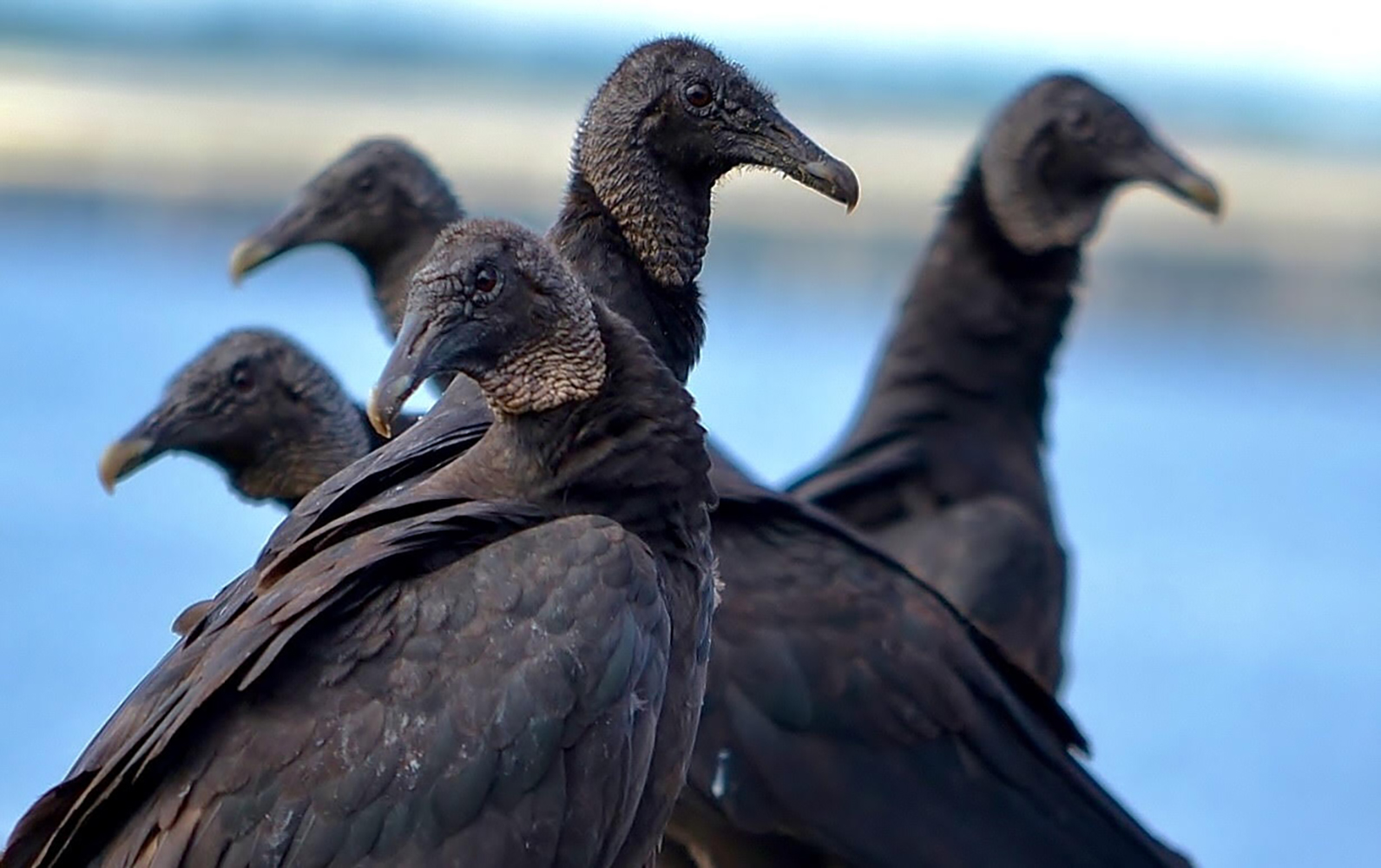
I was surprised to find only one bit of research on vulture urohidrosis working as an antiseptic—by Bridgette Gray at Florida State University in 2023.** Gray collected feces from three captive black vultures and then tried to grow various bacteria on that medium. Her results were laudable and spot-on, as she found that two gram-positive bacteria species, Bacillus coagulans and Staphlococcus aureus, were in fact inhibited by vulture poop!
*Cabello-Vergel, J, et al. 2023. Keeping cool with poop: urohidrosis lowers leg surface temperature by up to 6 degrees C in breeding white storks. Ecosphere 14. 10.1002/ecs2.4661
**Gray, BC. 2023. Characterization of antimicrobial properties of excrement and functional microbiome of black vultures (Coragyps atratus). MS Thesis. Jacksonville State University, FL.
 |
|---|
| Black vultures are able to kill bacteria on their legs by pooping on them. (JP Easton) |
•V•
VULTURES
You know what a vulture is—the big raptor with the non-feathered head, the bulky feathers, and flattish feet. Vultures eat almost exclusively carrion, and use soaring, eyesight, and sometimes olfaction as ways to find prey. Though often depicted in media as ugly, dopey, and even greedy, we would be waking up to a very different landscape without vultures around. In fact, their ecological role—the garbage collector—is so critical to the planet that vultures evolved twice.
Vultures in the Americas account for seven species, including the two condors (Andean and California), and are grouped as the family Cathartidae. Eurasian plus African vultures include 15 species that belong to the huge Accipitridae family, which also includes hawks, eagles, kites, and harriers—some 260 species in all. As interesting as this continental-level vulture-group split is, the story is more complicated than that. The earliest Cathartidae fossils are from France some 35-40 million years ago, and ancestors of the modern Egyptian vulture have been found in the La Brea tar pits of southern California.
Vultures seem very common in some landscapes, for example, the turkey vultures in central California where I live, but the 22 worldwide species are some of the most at-risk bird species in the world. In 2016, Evan Buechley and Çağan Şekercioğlu* conducted a global vulture conservation assessment, and their conclusions were sobering. Of 22 worldwide vulture species, nine are currently critically endangered, three are endangered, and four are threatened. Dietary toxins are the leading cause of decline for 88% of vulture species, and today we are in the midst of a global avian scavenger crisis. Buechley and Şekercioğlu warn that global vulture losses will create cascading conservation problems for many other species—including us.
*Buechley, ER, & ÇH Şekercioğlu. 2016. The avian scavenger crisis: looming extinctions, trophic cascades, and loss of critical ecosystem functions. Biological Conservation 198: 220-228.
 |
|---|
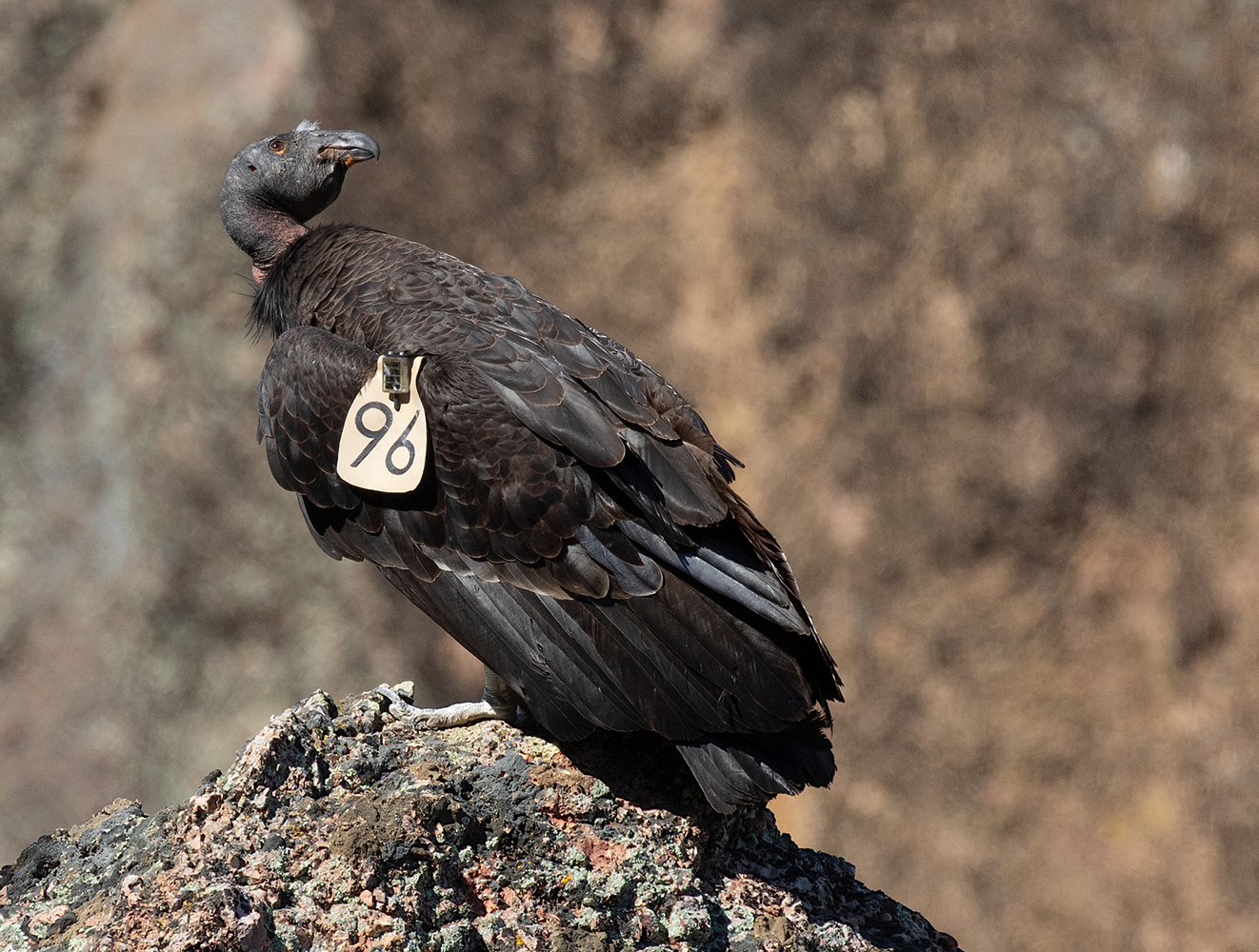
| California condors currently number about 500 (in the wild and in captivity). Their populations are still under threat, particularly by lead poisoning and avian flu. (Mark O’Brien) |
•W•
WINTERING
Swainson’s hawk flocks provide one of the most spectacular bird migration events in the Americas. After breeding across western North America, by September nearly all of the species starts flying south in grand flocks of 100s and 1000s of birds. They fly over valleys and plains using thermals for lift. They pass through Mexico to Panama, then cross the ridges of the Colombia Cordillera, eventually arriving in November in Argentina in time for winter.
But wait a minute, they’ve flown from the northern temperate zone to the southern temperate zone, covering 6,000+ miles in 3 months. They aren’t wintering. They are summering again! If not “wintering” in Argentina, what should we call this period? One option is to call it the “non-breeding” season, especially for temperate zone birds, whether migrating to the opposite hemisphere or staying close to the nest tree. The tropics are even more complicated, as nesting periods are less seasonal and more defined by rain events. But still, raptors are either breeding or non-breeding.
Non-breeding seasons have many challenges for raptors, especially when also wintertime, the non-growing season. Daylengths are shorter, vegetation dies back, invertebrates retreat or pupate, small vertebrates migrate or hibernate or die. This is when raptor band recoveries are most likely to happen, when mortality rates are at their highest.
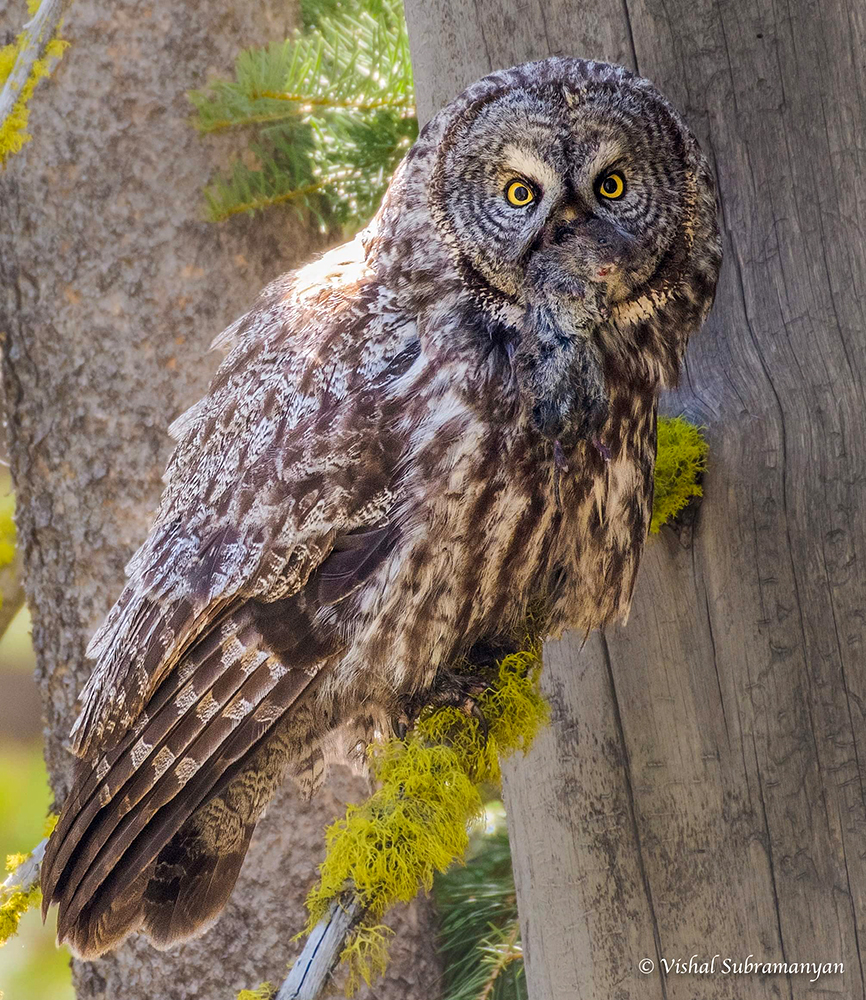
Sometimes hawks and owls might be killed by one cause, say, a window strike or severe weather, but raptor deaths often happen by a combination of factors. Imagine, for example, that a great gray owl near Yosemite snatches a wobbly-acting vole from the edge of a highway. The slug of rat poison it has ingested soon weakens the owl’s liver and slows its reactions. A few nights of freezing temperatures exacerbate the owl’s stress, and also reduces prey availability in the locale. A few days later, the weak and hungry great gray again hunts the highway edge at dusk and misjudges the car coming head on. Blinded and confused by headlights, it is soon struck and killed.
Would you call this a roadkill or a rodenticide kill? Or just wintertime mortality? How do we classify such an event? How do we keep data on what’s really going on in the field when there are layers of sublethal and often hidden impacts?
Beyond the stresses for any raptor during the non-breeding season, this is also a difficult time for a biologist to keep track of a hawk or owl that isn’t glued to a nest territory. Some raptors might stay at one non-breeding territory for a few months at a time, but many keep on the move, shifting locations to seek new sources of prey. New tracking techniques based on GPS and Motus technologies will be critical tools to help us understand the challenges faced by non-breeding season hawks and owls, but funds and committed field biologists can be hard to find.
 |
|---|
| The California population of great gray owls is a unique subspecies, numbering fewer than 200 birds, and classed as “endangered” by the California Department of Fish and Wildlife. (Vishal Subramanyan) |
•X•
EXHILARATION
As a raptor student for nearly half a century, I have often wondered: why are we exhilarated by raptors? Why do we get so excited by seeing hawks, eagles, owls, and falcons, even vultures? I have a theory I want to share with you. The poet Gary Snyder once asked: “Do you really believe you are an animal?” For argument’s sake, let’s say, yes, you are an animal. You and I evolved on this planet over millions of years to become one of the 54,000 vertebrate species. We are concerned about many things, but ultimately two things rise above all else—reproduction and survival.
Now consider again—why should we be exhilarated by raptors? The thrill of seeing an owl or an eagle often seems to go deeper and last longer in our brains than, say, the thrill of seeing a thrush or a shorebird. I suspect that you remember the last eagle you saw but how about the last sparrow? Why should this be? Here are two ideas.
First off, maybe raptors could have killed us—not too long ago. As recently as the 1400s, there was an immense bird of prey living on the island of New Zealand. Haast’s eagles weighed up to 40 pounds and had a wingspan of 10+ feet. Haast’s probably evolved to hunt the flightless Moa, which itself weighed up to 400 pounds. A few hundred years after the Maori arrived in New Zealand, Haast’s Eagles went extinct (and Moas about the same time) possibly because the Maori brought rats to the island, or because they hunted the Moa themselves. But here’s the question: Did Haast’s eagles eat people? There’s no clear evidence yet, but Maori people have long-carried a legend of a predatory bird called “Teltokioi” that was said to eat children. Hmmm.
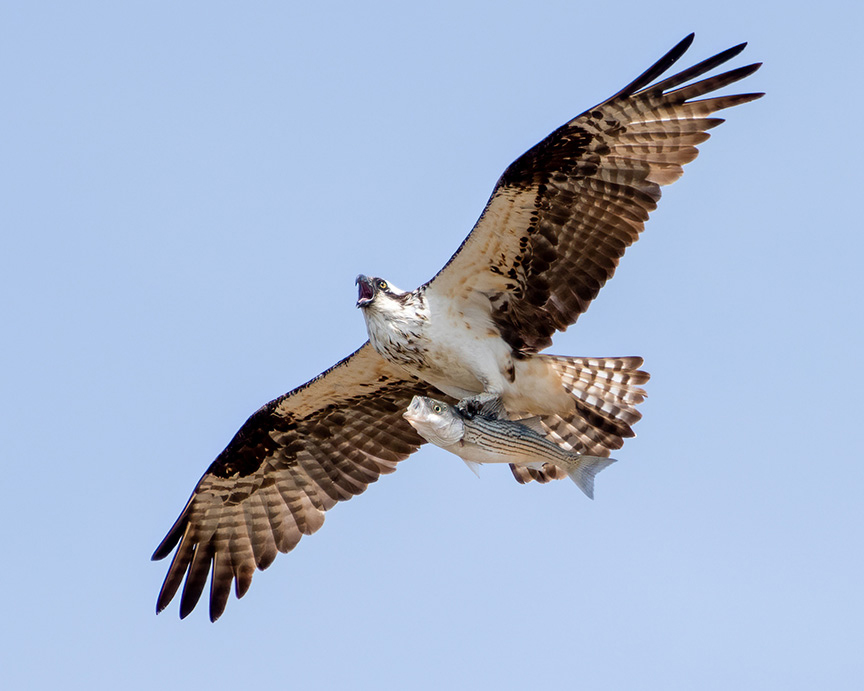
Secondly, remember back in school when you learned that raptors, like peregrine falcons and golden eagles were “barometers of ecosystem health”? Turns out, that’s true, both in theory and in actuality. Raptors are mostly big and visible predators, they are very mobile and likely better at assessing localized outbreaks of prey (e.g., mice, salmon, ducks) than we are. So, when we see a raptor, let’s say an osprey, hunting above a local waterway, we know that the fish are doing well here. Same for a screech-owl or a harrier or a vulture. It doesn’t matter that we don’t eat moths and snakes and roadkill, the mere presence of a raptor means that this place is likely to be an ecologically lucrative location. The ecosystem is producing prey here, and there’s a good chance that we—as early human animals—would benefit from sticking around and hunting.
All of this is to say, the next time you see a burrowing owl or a white-tailed kite and you feel that chemical-rush of thrill and exhilaration, consider your animal-role in the ancient ecosystem, and consider the possibility that you might eat well tonight. Or…you might be eaten.
 |
|---|
| One of the most specialist raptors in the world, osprey are indicators of good numbers of fish near the surface of rivers, lakes, or bays. Like us, even bald eagles watch osprey hunt, but they are waiting for the off-chance to steal their prey. (Steve Porter) |
•Y•
YUROK CONDOR RESTORATION
For 1,000s of years the Yurok Tribe have lived along the Klamath River in coastal California near Oregon. For the past 150 years, the region and the Yurok people have been missing their apex scavenger, the California condor. During the 19th and 20th centuries, the largest-winged landbird on the North American continent was eliminated from much of its range by shooting, collecting, poisoning, and the overharvesting of condor prey by colonists. By 1987, only 17 condors were left in the wild in a small, hot, and mountainous region of southern California.
Some 25 years ago, a panel of Yurok elders discussed what the tribe’s greatest cultural and natural restoration needs should be; it was decided that bringing condors back to the Pacific Northwest was a critical gap to be filled. The tribe began dialogues with U.S. Fish and Wildlife Service and National Park Service biologists. They spent 14 years assessing contaminants in the region, especially lead and rodenticides; they accelerated vigorous campaigns among hunters and growers of the region to not use these poisons.
From 2022 to 2025, 18 condors were released into the wild by Yurok biologists, who carefully monitored them using radio- and satellite-trackers. What an incredible thing to imagine, these ancient-eyed, nine-foot wingspan birds gliding past magnificent forests along the Klamath River.
Sadly, in 2024-2025, two Klamath condors were found with severe lead-poisoning. In October 2024, Condor A9 was trapped, treated with blood chelation, and released back to the wild. In January 2025, Condor B7, just 18 months old, died outright from lead poisoning. The tiniest bits of lead, often pellet fragments from hunters’ gut piles, can kill a condor.
These challenges remind us that there are no straight paths, and that we cannot be deterred from envisioning magnificent and critical ecological restoration. I am so inspired by the Yurok elders and biologists for fully committing to condor restoration, for starting down a long path toward wildlife conservation goals that don’t separate ecosystem, spiritual, and human health into artificial and independent buckets.
To learn more on the work of the Yurok Wildlife Program, to watch the Condor Live Cam, and especially to make a donation to the Pacific Northwest Condor Conservation Restoration Program, visit:
Yurok Condor Restoration Program | Yurok Tribe
 |
|---|
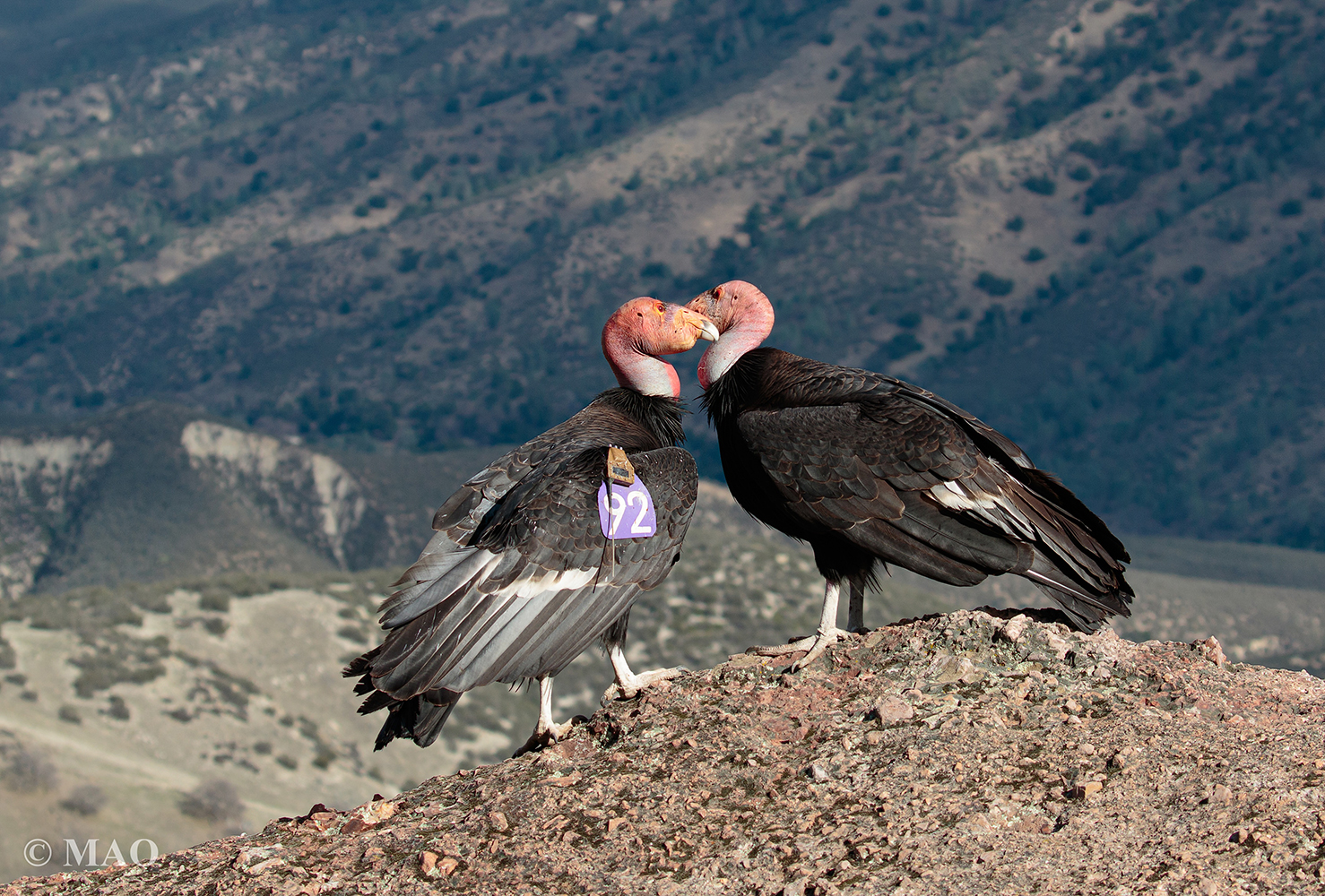
| Part of the strategy of the Yurok Condor Program is to better spread out the California condor groups geographically, so that an avian flu outbreak won’t cause a full-on species extinction. These Pinnacles National Park condors are part of one of the longest standing populations. (Mark O’Brien) |
•Z•
ZUGUNRUHE
Simply put, zugunruhe is migratory restlessness—the agitation and fidgetiness that gets many birds started on their fall and spring migrations. The term goes back at least to the 18th century. By the mid-20th century, ornithologists began figuring out ways of measuring the behavior, essentially quantifying “migratoriness” in captive birds, usually songbirds. Try a web-search for the “Emlen Funnel” to read more about one of these innovations.
What about zugunruhe in birds of prey? Do raptors get agitated at the start of their migrations? Do hawks and owls show directional tendencies to fly toward the equator during autumn migration? Absolutely yes. Humans have been observing raptor migration in the field for many thousands of years. But can this stimulation of migration be measured in captive raptors?
Honey buzzards migrate by the thousands from European nesting grounds to sub-Saharan Africa for winter. In the early 2000s, Michael Stoltz* closely observed three honey buzzards that had been captive for 10+ years and recorded significant increases in their flapping and excitability in October, an apt time for the peak of fall migration.
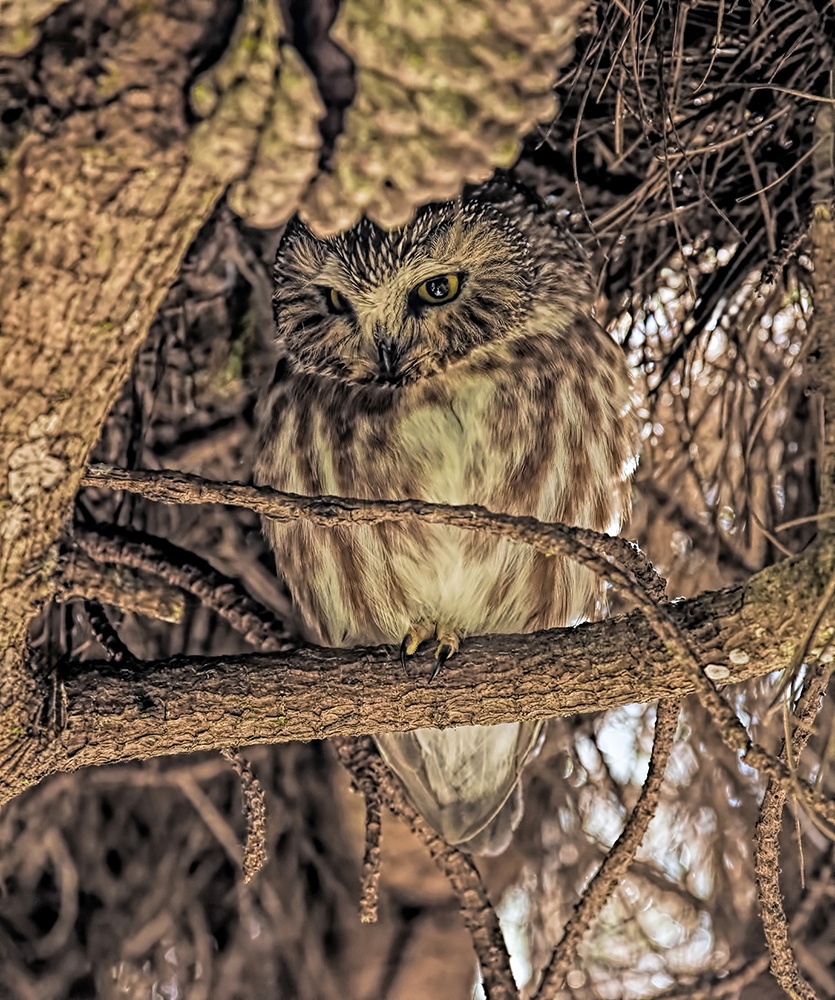
More recently, Rhonda Smith, a Master’s student in Boise State University’s Raptor Biology program created “orientation cages” to test for zugunruhe in captive flammulated and northern saw-whet owls.** Of the two species, flamms are more directional, southbound autumn migrants, while saw-whets are more variable in their fall flights, with some migrating and some wandering about. Smith documented that 4 of 16 (25%) of the flammulated owls displayed restlessness with a directional “southward” tendency, while 59 of 97 (61%) of the saw-whets showed restless behaviors, also pointed south.
Although the owl results are somewhat counterintuitive, these two raptor studies are a good start. More work could teach us much more about zugunruhe in birds of prey, about the interplay of genetics and environment that create a specific kind of raptor movement, whether migration, dispersal, irruption, nomadism, or even sedentariness.
*Stoltz, M. 2005. First evidence on migratory restlessness on a species of birds of prey (honey buzzard, Pernis apivorus). Vogelwarte 43: 133-135.
**Smith, RF. 2009. Investigating raptor migration behavior using orientation cages and wing measurements: a comparison of the flammulated owl and the northern saw-whet owl in southwestern Idaho. Master’s thesis. Boise State University.
P.S. From the Natal Dispersal essay. On average, female humans disperse farther from the natal territory than males. See the innovative article by Walt Koenig on this topic:
Koenig, WD. 1989. Sex-biased dispersal in the contemporary United States. Ethology and Sociobiology 10: 263-278.
 |
|---|
| In studies of northern saw-whet owls, 60% of nearly 100 owls showed migratory restlessness, and with a tendency to fly in the correct migratory direction. (Pamela Rose Hawken) |
We thank CuriOdyssey for their support of this page.